
Permanent Residency
Explore skilled migration and permanent residence pathways based on your profile and goals.
Explore PR Options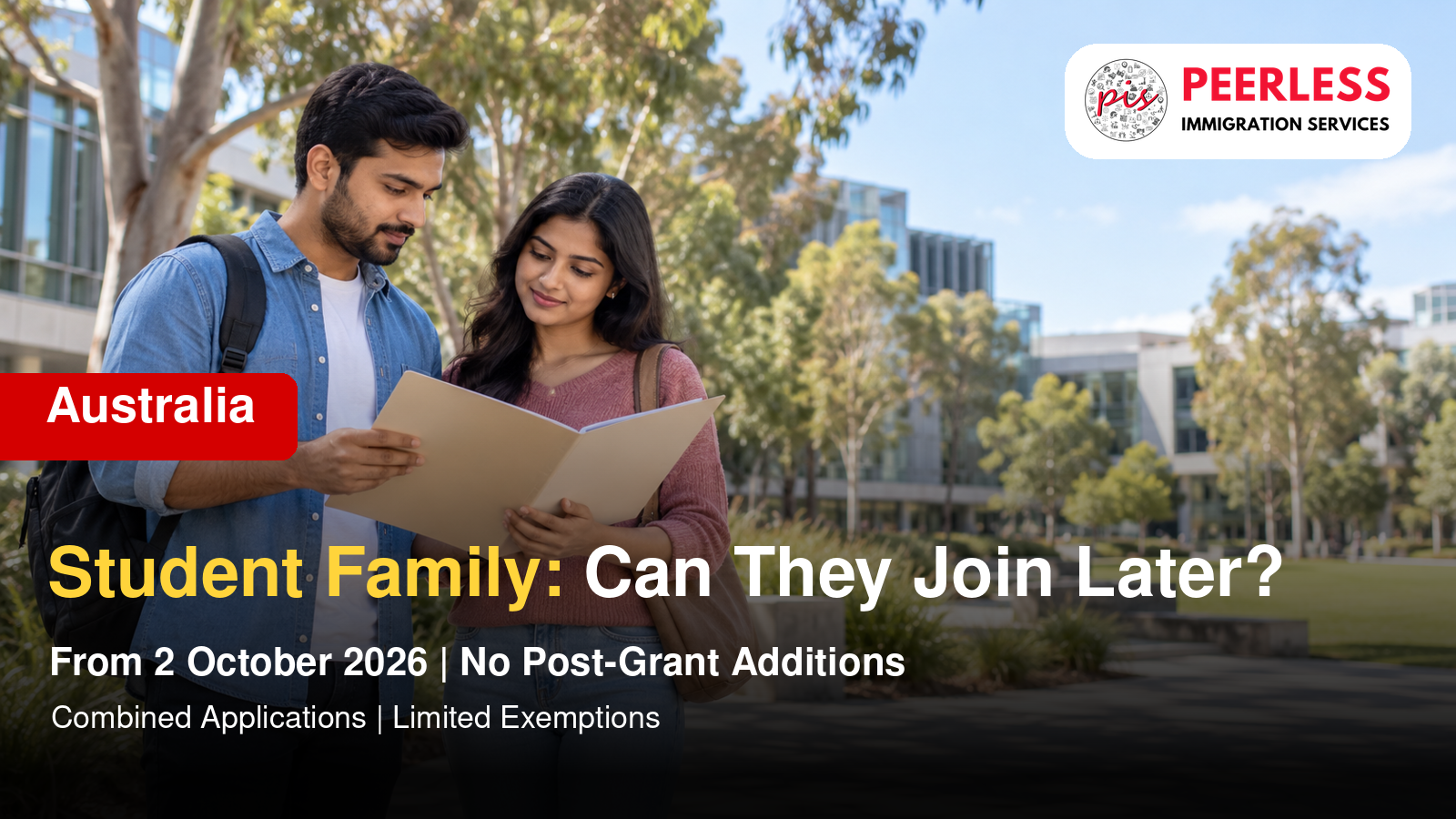
If your spouse already holds an Australian Student visa and the plan is for you to join later, the current rules need attention before you spend money on an application. Older explanations of a subclass 500 subsequent entrant are no longer a safe basis for a new plan.
Home Affairs' guidance, checked on 31 October 2026, describes changes from 2 October 2026. Family inclusion when lodging an eligible application and adding family after a visa grant are different situations.
The current family-rules page says Student visa holders cannot add family members after their visa has been granted, and that there are no exemptions to that post-grant restriction. Do not confuse an exemption for including family in a combined application with permission to add them later.
For an Indian couple, this means the familiar plan of one spouse travelling first and the other filing a new dependent Student visa application later must not be presented as an available routine pathway under the current rules.
| Your situation | Current planning position |
|---|---|
| You already hold a Student visa and want to add family now | The published post-grant rule does not allow adding subsequent entrants; no exemption is stated. |
| You are lodging a Student visa application and want to include family | Family inclusion is restricted to qualifying exemption categories. |
| A Student visa application was lodged before 2 October 2026 | Home Affairs says it continues under the rules in place when lodged, including applications that included family. |
| Family members already hold visas | The fact sheet says the changes do not affect the current Student visa. A later application is a separate question. |
Keep copies of the actual lodgement acknowledgement, visa decision and family details. The date a course was booked or a consultant was paid is not the same as an application lodgement date. A plan based on an earlier discussion needs to be checked against the application that was actually submitted.
Home Affairs lists limited categories, including PhD students, DFAT or Defence-sponsored students, foreign-government scholarship recipients, and eligible Pacific or ASEAN students. These are conditional categories, not a blanket exemption for every international student.
The guidance also describes limited situations for family already included on a current visa when a further application is made. It includes specified course-completion or provider-default circumstances. Applicants and family included in a combined application must be in the same location when lodging.
Do not assume that studying a master's degree alone creates an exemption. Record the exact qualification, funding arrangement, existing family visas and proposed application location. Any exception needs to match the actual circumstances.
The official fact sheet preserves the former assessment rules for Student visa applications lodged before 2 October 2026, including those that included family. It does not say that every family of a person who studied or obtained a visa before that date can lodge a new subsequent-entrant application now.
Separate an application already lodged from a future application that has only been discussed. If an older file is pending, its precise lodgement and contents need review. Avoid withdrawing, replacing or paying for a different application merely because a general online article appears to describe similar facts.
Prepare an accurate chronology of marriage or partnership, course and enrolment, visa applications, grants and family travel. Keep scholarship or sponsorship evidence where an exemption is being considered. These records help identify the relevant rule; they do not create eligibility by themselves.
A generic proof-of-funds figure or relationship checklist cannot overcome the restriction on new post-grant additions. For a permitted combined application, the applicable evidence and charges must be assessed for that application. This guide does not quote a fee or processing time for a new subsequent-entrant route that the current guidance does not permit.
Before committing to medical examinations, insurance, accommodation or flights, resolve whether the intended application is permitted. A payment or strong bank balance does not guarantee that a family member can be added.
For someone who already has a visa, work rights depend on the actual visa and its conditions. Home Affairs' VEVO service provides current visa-condition information. A description such as student spouse does not establish unrestricted work rights.
If a different visa is being considered, it needs its own eligibility assessment. Do not treat a visitor visa or a separate study plan as an automatic replacement that provides the same stay or employment rights.
Our Australia Partner visa page concerns a different partner pathway, rather than permission to join a temporary student. The broader family visa overview can help frame a discussion about the correct category.
Peerless Immigration Services can organise the application timeline and supporting records, explain which questions need individual assessment and help avoid relying on an outdated sequence. Share the actual visa grants and lodgement dates, rather than only the course name. No visa, work rights, family inclusion or PR outcome is guaranteed.
Call +91-8595010514 or email info@peerlessimmigration.com.
The current Home Affairs guidance says family cannot be added after grant and states there are no exemptions to that restriction.
Do not treat it that way. The listed exemption concerns including family when applying; the post-grant restriction is stated separately.
The official fact sheet says the changes do not affect the current Student visa. A further application needs separate assessment.
Home Affairs says it is assessed under the rules in place at lodgement, including applications that included family. Preserve evidence of what was lodged and when.
No. Supporting evidence does not remove the requirement that the intended application be permitted.
No. Check the actual visa conditions; a relationship description alone does not establish work authorisation.
Practical guidance across immigration, international mobility, family visas and language preparation.
Explore skilled migration and permanent residence pathways based on your profile and goals.
Explore PR OptionsExplore eligible job-search visa and residence pathways in selected destinations.
Explore Job Seeker VisasExplore residence options for eligible remote workers and internationally mobile professionals.
Explore Digital Nomad VisasLearn about investment-linked residence options and other eligible European pathways.
Explore Residency Options
Get application guidance for tourism, visiting family and other short-term travel.
Explore Visitor Visas
Explore eligible sponsorship routes for spouses, partners, parents and family members.
Explore Family VisasExplore employer-supported work permit options and suitable overseas employment pathways.
Explore Work PermitsPrepare with guided online lessons, study materials, practice tests and feedback.
Explore Coaching


