
Permanent Residency
Explore skilled migration and permanent residence pathways based on your profile and goals.
Explore PR Options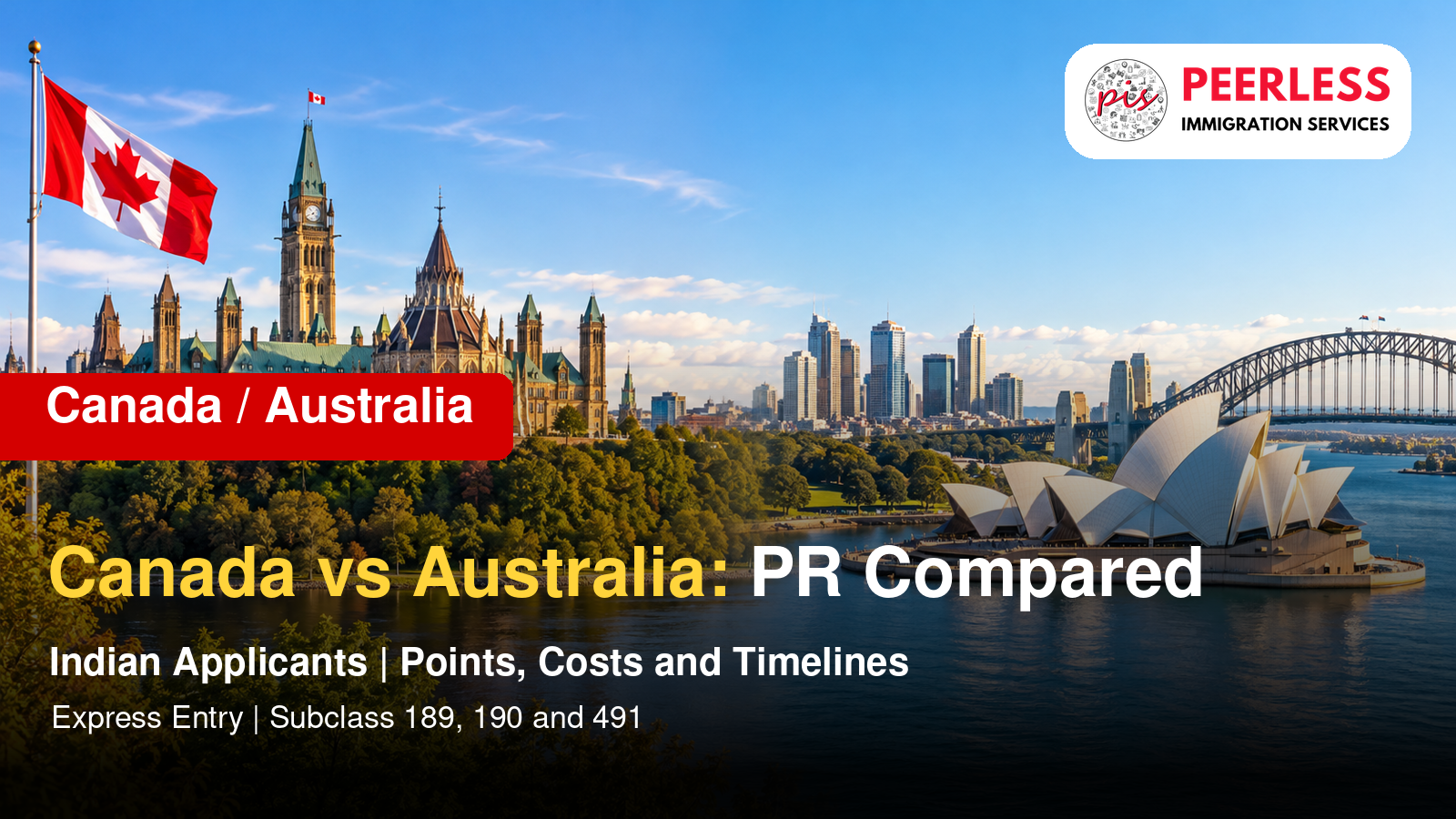
Canada or Australia for PR? For an Indian skilled applicant, the useful comparison starts with the route you can qualify for, your realistic invitation prospects and the cost of reaching that stage. A lower application fee or a minimum points score does not establish that one country will be easier for your profile.
This guide compares Canadian economic immigration through Express Entry with Australia's points-tested skilled routes. It does not cover every family, employer-sponsored or business pathway. Facts and published fees were checked on 29 October 2026.
| Question | Canada: Express Entry focus | Australia: points-tested skilled focus |
|---|---|---|
| How is a profile considered? | Meet an underlying program's requirements, then compete under Express Entry ranking and the applicable round. | Check the nominated occupation, skills assessment and visa requirements, then submit a SkillSelect EOI. |
| What do the minimum points mean? | The Federal Skilled Worker Program uses a 67/100 selection threshold. This is different from the CRS used to rank pool profiles. | The EOI threshold for subclasses 189, 190 and 491 is 65 points. Reaching it does not guarantee an invitation. |
| Is every route permanent immediately? | The economic application discussed here is for permanent residence, after invitation and assessment. | 189 and 190 are permanent visas. Subclass 491 is a five-year provisional regional visa with a later PR pathway subject to eligibility. |
| What is the nomination distinction? | Provincial programs have their own stream conditions; avoid treating every PNP as the same route. | 190 requires state or territory nomination. For 491, state/territory nomination or eligible-relative sponsorship is required. |
For Canada's Federal Skilled Worker Program, assess the required paid, continuous skilled work experience, approved language results and education. Foreign education normally needs an Educational Credential Assessment for this route. Meeting the minimum requirements and the 67-point selection threshold allows consideration for the pool; it is not an invitation cutoff.
For Australia, assess the occupation and the relevant assessing authority before paying for an unsuitable application. The subclass 189 points-tested route requires the applicant to be under 45 at invitation. Turning 45 before an invitation can therefore change the available strategy. Do not assume that the Canadian selection grid and Australian points test are interchangeable.
A practical comparison should use your documented duties, qualification, age, language results and accompanying-partner circumstances. Assess both partners as possible principal applicants before deciding which country's route deserves the larger investment.
A job offer is not a universal requirement for every Express Entry applicant. The underlying Canadian program and any provincial stream still determine eligibility. Australia's subclass 189 is an independent route rather than an employer-nominated visa. State nomination and regional pathways have separate conditions, so a rule from one route should not be applied to all of them.
These are published starting government charges for the named routes, checked on 29 October 2026. They are not complete relocation budgets or quotations for every family.
| Route or charge | Published amount | Scope |
|---|---|---|
| Canada economic PR: principal applicant | CAD 1,590 | CAD 990 processing fee plus CAD 600 right of permanent residence fee. |
| Canada: accompanying spouse/partner | CAD 1,590 | Processing plus right of permanent residence fee. |
| Canada: dependent child | CAD 270 per child | Separate from adult charges. |
| Canada biometrics, where required | CAD 85 individual; CAD 170 family maximum | Family maximum applies to eligible family applications at the same time. |
| Australia subclass 189: principal applicant | From AUD 6,135 | Published main-applicant charge; limited concessions apply. |
| Australia subclass 190: principal applicant | From AUD 6,140 | Published main-applicant charge; limited concessions apply. |
| Australia subclass 491: principal applicant | From AUD 6,140 | Published main-applicant charge; provisional visa rather than immediate PR. |
CAD and AUD are different currencies: the figures should not be compared as if they were rupees. For an INR budget, use a dated exchange rate and allow for payment costs. Language exams, education or skills assessments, medical examinations, police certificates, translations, any nomination charges and professional assistance may be additional. Australian family-member charges and any applicable second instalment require a personal calculation.
Settlement funds are separate from application fees. Canada's proof-of-funds requirements depend on the program and circumstances, including specified exemptions. Money needed to demonstrate settlement capacity should not be confused with a fee paid to the government. Budget separately for travel and initial accommodation.
Separate preparation, waiting for selection and processing after lodgement. An applicant may spend time obtaining language results or assessments before joining a pool; there is no reliable total timeline based only on a published processing figure.
| Published measure | What it tells you | What it does not tell you |
|---|---|---|
| Canada: six-month Express Entry service standard | IRCC reports that about 76% of FSW and CEC applicants received a decision within that standard during September 2025–August 2026. | It does not promise a decision for every application or include an individual's wait for an invitation. |
| Australia: eight-month skilled permanent median for August 2026 | This is a broad published category measure for decided applications. | It is not an offshore 189/190-specific forecast and does not measure the wait for an EOI invitation. |
These measures cover different populations and should not be used to declare an automatic winner. Occupation fit, selection opportunities, nomination requirements and document readiness can matter more to an individual plan than the headline processing figure.
As at 29 October, IRCC says changes to Canadian-experience and qualifying-job-offer points are scheduled for 3 November 2026. It also describes profile recalculation taking up to two weeks, with invitation rounds paused during recalculation. These are announced future changes, not rules already operating on the publication date. A personal comparison should be reviewed when they take effect; this article does not assume an unverified post-change CRS total or predict future draw cutoffs.
Investigate Canada first if the evidence supports an eligible program and a credible way to compete in the relevant pool. Investigate Australia first if the occupation assessment, age and visa or nomination conditions fit your record. These are profile-review priorities, not predictions of approval.
Before paying several separate assessment and testing fees, prepare a side-by-side record of the principal applicant, supporting documents, costs, location commitments and the main uncertainty for each route. Where both routes remain realistic, decide which documents can be prepared first and which spending depends on an unresolved eligibility question.
For country-specific details, read our Canada PR process guide and Australia skilled PR guide.
PEERLESS IMMIGRATION SERVICES can review your profile and help you compare the relevant route, evidence and budget. No job, invitation, nomination or PR outcome is guaranteed.
Call +91-8595010514 or email info@peerlessimmigration.com.
There is no single answer. Compare program eligibility, documented occupation and experience, language results, selection prospects and location requirements for your own profile.
No. The Canadian figure is the FSW selection threshold, separate from CRS ranking. The Australian figure is the minimum threshold for the named points-tested routes; it does not guarantee an invitation.
No. It is a five-year provisional regional visa. A later permanent residence application depends on meeting the relevant requirements.
No. Assessments, exams, medicals, translations, other applicable charges and relocation expenses can be additional. Family costs also depend on the people included.
No. These published measures have different scopes and do not include all preparation and selection waiting. They are not personal completion dates.
No. Requirements depend on the underlying program and any provincial stream. A job offer should not be treated as a universal requirement or a guarantee of selection.
Practical guidance across immigration, international mobility, family visas and language preparation.
Explore skilled migration and permanent residence pathways based on your profile and goals.
Explore PR OptionsExplore eligible job-search visa and residence pathways in selected destinations.
Explore Job Seeker VisasExplore residence options for eligible remote workers and internationally mobile professionals.
Explore Digital Nomad VisasLearn about investment-linked residence options and other eligible European pathways.
Explore Residency Options
Get application guidance for tourism, visiting family and other short-term travel.
Explore Visitor Visas
Explore eligible sponsorship routes for spouses, partners, parents and family members.
Explore Family VisasExplore employer-supported work permit options and suitable overseas employment pathways.
Explore Work PermitsPrepare with guided online lessons, study materials, practice tests and feedback.
Explore Coaching


