

Permanent Residency
Explore skilled migration and permanent residence pathways based on your profile and goals.
Explore PR Options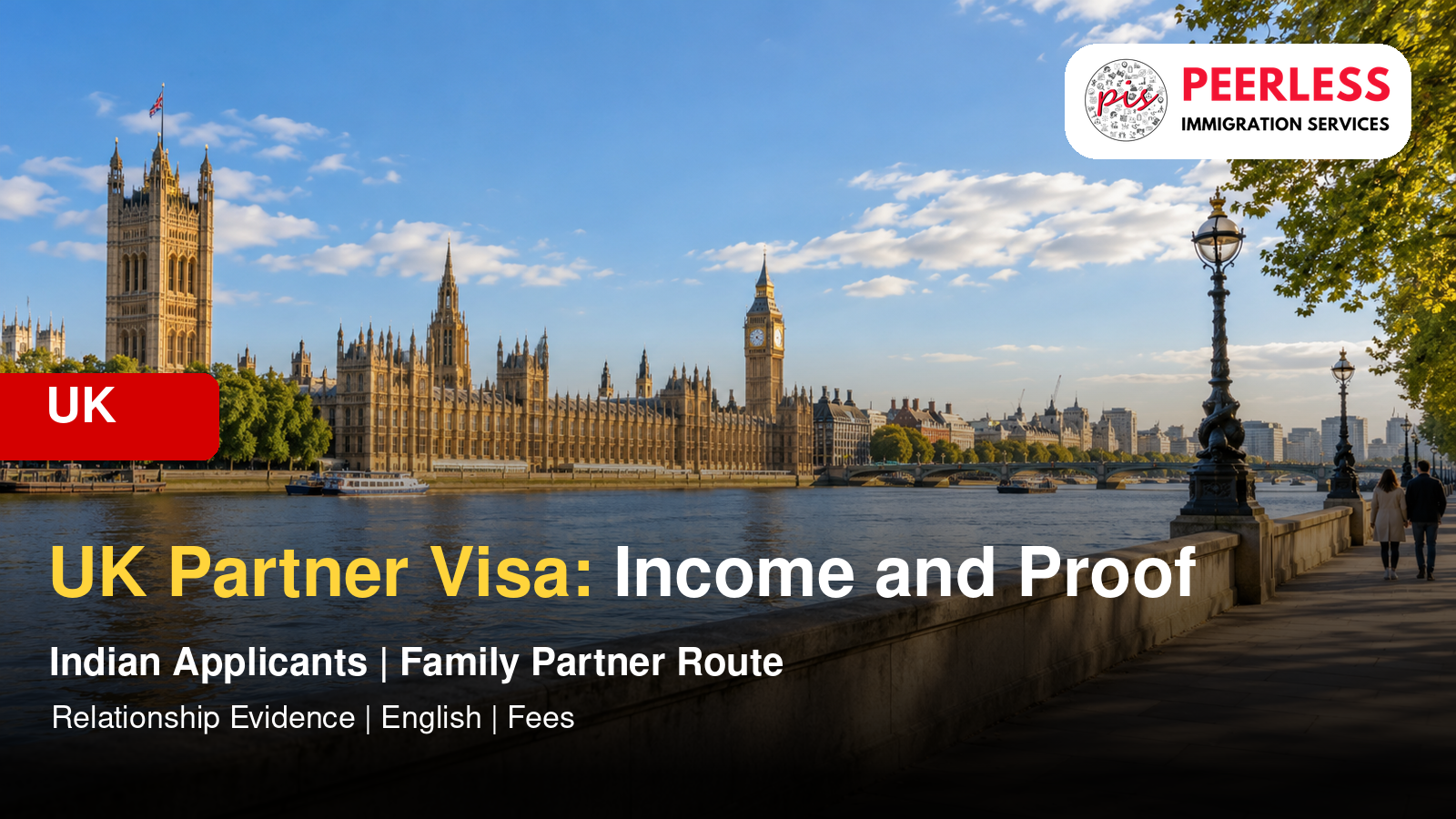
For an Indian applicant joining a partner in the UK, the first question is the partner's immigration status. A family partner visa and a dependant visa are different routes. The income test, relationship evidence and budget must match the correct application.
This guide covers ordinary family-partner planning, particularly joining a British or settled partner. Requirements and published charges were checked on 30 October 2026. It complements our family sponsorship overview.
Both partners must be at least 18 and intend to live together permanently in the UK. British or Irish citizenship and settled status are among the qualifying sponsor categories; other specified statuses also qualify. Establish the sponsor's exact status before preparing the application.
If your spouse is temporarily in the UK on a work or student visa, assess the relevant dependant route instead. A visitor usually needs to leave the UK to apply for a family visa. Do not plan a visitor trip as an automatic route to switching status.
A UK-recognised marriage or civil partnership can establish the relationship category. Unmarried partners can qualify through at least two years of living together, or a relationship of at least two years where living together has not been possible, including work, study or cultural reasons.
For couples living apart, explain the circumstances and show continuing commitment through relevant contact, visits, financial support or shared parenting. Prepare a truthful chronology rather than assuming wedding photographs alone answer every question.
The ordinary partner-route threshold is £29,000 a year. Different arrangements apply to qualifying cases involving specified disability or carer's benefits, and some extensions following a first partner application before 11 April 2024. Those exceptions require a separate assessment; they are not a general waiver.
For someone applying from India, do not simply add their Indian salary to the UK sponsor's salary. The standard employment categories use the sponsor's earnings, or the applicant's earnings where the applicant is in the UK with permission to work. A sponsor returning from overseas has additional conditions. The source of the money matters as much as the amount.
| Financial planning question | What to prepare |
|---|---|
| Employment income | Payslips, matching bank credits and an employer letter; the category determines the relevant period and calculation. |
| Savings instead of income | For a £29,000 initial-application threshold with no qualifying income, the standard cash-savings calculation gives £88,500: £16,000 + (2.5 × £29,000). |
| Ownership and holding period | Qualifying cash savings generally need to have been held for at least six months under the applicant’s or partner’s control. Specific exceptions and evidence rules apply. |
| Other sources | Pension, specified non-employment income and self-employment have their own evidence and combination rules. |
A recent pay rise, new job, variable earnings or a business income record needs the correct category calculation. Avoid treating an account balance or a salary headline as a completed financial assessment.
For a first application using the test route, the published minimum is CEFR A1 with an approved Secure English Language Test provider. A degree taught in English outside the UK needs an Ecctis assessment confirming the required equivalence and English medium; a college letter alone should not be assumed sufficient.
For an extension after 2.5 years, someone who originally passed A1 normally needs at least A2 in speaking and listening. Exemptions and reuse conditions apply. Choose evidence for the family route rather than booking an unrelated English examination.
The following figures describe one adult applying from outside the UK for the ordinary partner route. They exclude children, professional fees, tests, translations, travel and optional services.
| Charge | Published amount | Budget note |
|---|---|---|
| Outside-UK application fee | £2,064 | Per applicant; separate from the healthcare surcharge. |
| Adult healthcare surcharge for 2 years 9 months | £3,105 | Based on the published duration example; the actual charge depends on the permission period. |
| Illustrative government total | £5,169 | £2,064 + £3,105 for this example, before other costs. |
These are pound-sterling charges, not a fixed rupee quotation. Keep a separate allowance for currency conversion and payment-provider charges rather than presenting an unverified INR total.
Prepare identity and immigration-history records, relationship evidence, financial documents and English evidence. Certified translations are required for documents outside English or Welsh. TB evidence may also be required depending on the applicable testing rules.
The published usual decision time for an application outside the UK is 12 weeks. This is an estimate, not a guaranteed travel date. Resolve missing evidence before making commitments that depend on approval.
For future travel planning after permission is granted, our UK eVisa guide explains the separate digital-status considerations. This article does not promise approval or permanent residence.
Prepare the sponsor's status, relationship timeline, income source and employment history before your consultation. Peerless Immigration Services can help organise the relevant questions and document gaps within its family-visa service scope. Any issues needing regulated legal advice require the appropriate professional.
Call +91-8595010514 or email info@peerlessimmigration.com.
That normally requires assessment under the relevant dependant rules, rather than this family-partner route.
No. The standard employment categories do not simply combine an overseas applicant’s Indian salary with the sponsor’s UK salary. The applicable income category needs checking.
They can, subject to the cash-savings rules. The standard initial-application savings-only calculation at this threshold is £88,500; ownership, holding period and evidence still matter.
No. The published criteria also cover a relationship of at least two years where living together has not been possible for specified reasons. Evidence of commitment remains necessary.
No. Where relying on a test, use an approved SELT meeting the required level. Degree-based evidence and exemptions have separate conditions.
No. They are separate charges. In the adult outside-UK example above, £2,064 plus £3,105 gives £5,169 before other costs.
Practical guidance across immigration, international mobility, family visas and language preparation.
Explore skilled migration and permanent residence pathways based on your profile and goals.
Explore PR OptionsExplore eligible job-search visa and residence pathways in selected destinations.
Explore Job Seeker VisasExplore residence options for eligible remote workers and internationally mobile professionals.
Explore Digital Nomad VisasLearn about investment-linked residence options and other eligible European pathways.
Explore Residency Options
Get application guidance for tourism, visiting family and other short-term travel.
Explore Visitor Visas
Explore eligible sponsorship routes for spouses, partners, parents and family members.
Explore Family VisasExplore employer-supported work permit options and suitable overseas employment pathways.
Explore Work PermitsPrepare with guided online lessons, study materials, practice tests and feedback.
Explore Coaching


