Canada Express Entry Changes 2026: New CRS Points and LMIA Rules from 3 November
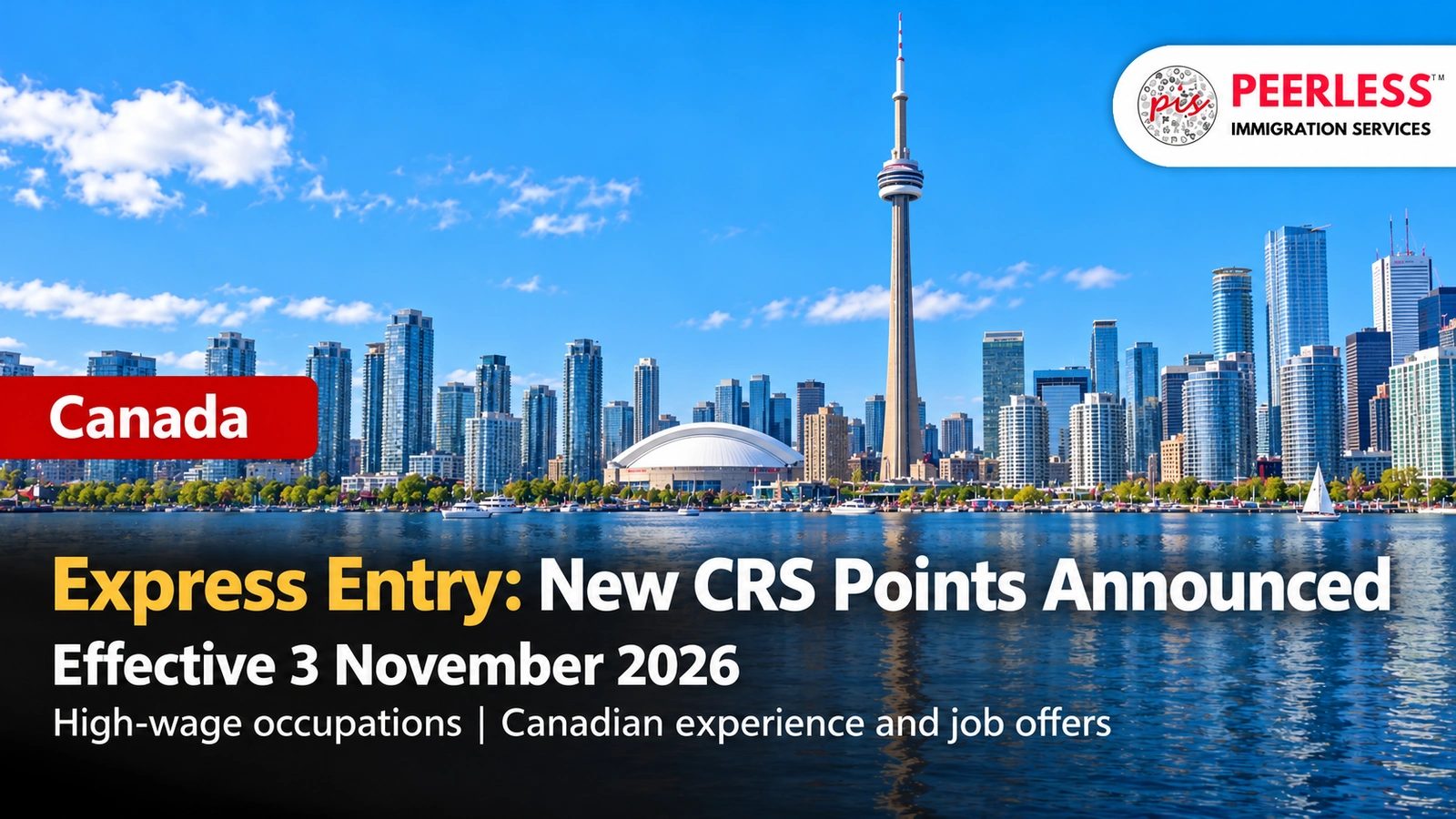
Canada has announced new Express Entry points for eligible Canadian work experience and job offers in high-wage occupations. The changes take effect on 3 November 2026, following Immigration Minister Lena Metlege Diab's announcement on 16 October.
For applicants, the important distinction is where the experience was gained and which occupation it falls under. A high salary in India does not, by itself, earn the new Canadian work-experience points.
What changes on 3 November?
A new Labour Market Integration factor will compare two scores: eligible Canadian work experience, including any high-wage bonus, versus a qualifying high-wage job offer. Candidates receive the higher score, not the two added together. The factor allows up to 150 points without an accompanying spouse or partner, or 140 with one.
IRCC will also remove the LMIA requirement for qualifying Express Entry job offers used for CRS points or Federal Skilled Worker and Federal Skilled Trades eligibility. Officers will still assess whether each offer is genuine.
New job-offer points and Canadian experience bonuses
| Occupation wage level | Qualifying job-offer points | Extra Canadian experience points |
|---|---|---|
| At least 2 times the national median | 100 | 70 |
| At least 1.5, but below 2 times | 70 | 40 |
| At least 1.3, but below 1.5 times | 50 | 20 |
The experience bonus requires at least 12 months of eligible Canadian work in the relevant high-wage occupations. Higher-tier points take precedence; the bonuses are not cumulative. Ordinary points for the duration of eligible Canadian experience continue even when the occupation does not qualify for a high-wage bonus.
Those duration points remain:
| Canadian experience | With accompanying spouse/partner | Without accompanying spouse/partner |
|---|---|---|
| Less than 1 year | 0 | 0 |
| 1 year | 35 | 40 |
| 2 years | 46 | 53 |
| 3 years | 56 | 64 |
| 4 years | 63 | 72 |
| 5 years or more | 70 | 80 |
Example: A candidate without an accompanying spouse has two years of eligible Canadian experience, including sufficient experience at the middle high-wage level: 53 + 40 = 93 points. If the same candidate also has a qualifying top-tier job offer worth 100, this factor awards 100, not 193. Other CRS factors are assessed separately.
Which occupations qualify?
IRCC classifies occupations using national median wages for each NOC, not the individual's salary. Its list uses 2023-2025 wage data. Examples include:
| Wage tier | Examples on the list |
|---|---|
| At least 2 times | Engineering managers (20010); general practitioners and family physicians (31102); nurse practitioners (31302) |
| At least 1.5 times | Advertising, marketing and public relations managers (10022); data scientists (21211); software engineers and designers (21231) |
| At least 1.3 times | Financial auditors and accountants (11100); architects (21200); web developers and programmers (21234) |
These are examples, not the complete occupation list. A job title alone does not establish the correct NOC. Where the list changes after an invitation, IRCC retains the occupation level applicable on the invitation date.
What does the LMIA change actually mean?
It concerns qualifying job offers within Express Entry; it is not an announcement abolishing LMIAs across all work-permit routes. A qualifying offer generally needs full-time, continuous Canadian employment for at least one year after permanent residence, with specific provisions for some trades and physicians.
A job offer outside the high-wage list can still support Federal Skilled Worker or Federal Skilled Trades eligibility if it meets that program's rules, while earning no high-wage CRS job-offer points. Program eligibility and CRS ranking are separate assessments.
What happens to candidates already in the pool?
Existing profiles will have their scores recalculated when the changes take effect. IRCC says this may take up to two weeks, with invitation rounds paused during recalculation and resumed afterwards. Candidates seeking job-offer points need their required offer information in the profile before 3 November.
Applicants can read our Express Entry overview and Canadian Experience Class guide for the underlying pathways. This article explains the announced November scoring changes; additional points do not guarantee an invitation or PR approval.
Understand how the new rules affect your Canada PR plans
PEERLESS IMMIGRATION SERVICES can assess your occupation, Canadian experience and job offer together, explain which score applies, and discuss your wider Canada PR options. Request an individual assessment rather than assuming that every high-wage occupation attracts the same points.
Call +91-8595010514 or email info@peerlessimmigration.com.
Discuss My Express Entry Profile
Frequently asked questions
No. The announcement was made on 16 October 2026; the changes take effect on 3 November 2026.
Overseas experience alone does not qualify for this Canadian experience bonus. A separate qualifying Canadian high-wage job offer may attract job-offer points.
No. IRCC compares the two options under Labour Market Integration and awards the higher score.
No. The tier follows IRCC's NOC-based national occupation classification, not your personal salary.
No. From 3 November, an LMIA will not provide additional CRS points or profile priority under these job-offer rules. The offer must still satisfy the applicable requirements.
No. IRCC describes a pause while existing profiles are recalculated, which may take up to two weeks, followed by the resumption of rounds.