

Permanent Residency
Explore skilled migration and permanent residence pathways based on your profile and goals.
Explore PR Options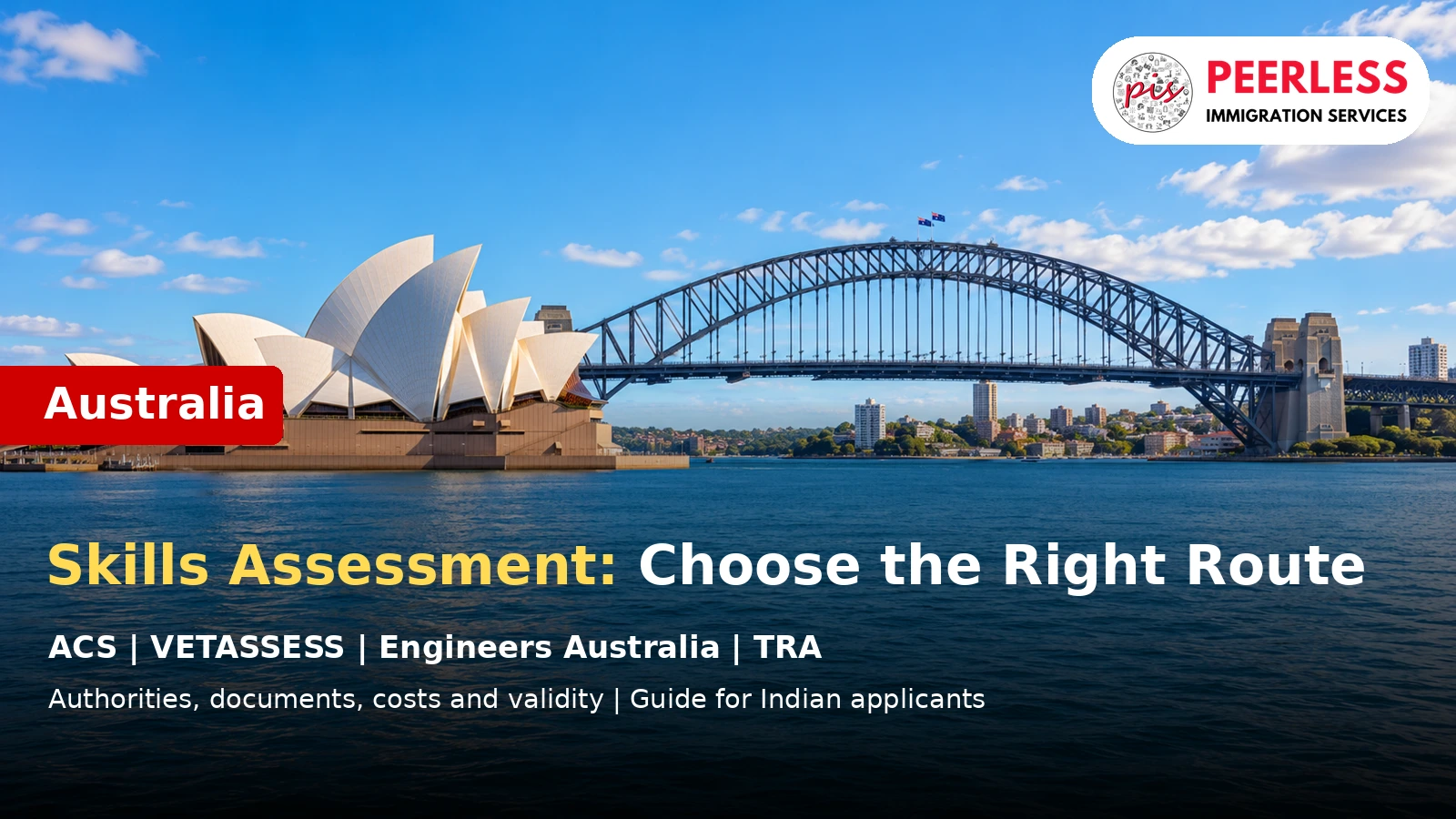
For an Indian applicant planning Australia PR, the first assessment decision is the occupation you can substantiate. Your designation, degree title and day-to-day work may point in different directions. Paying an assessor before resolving that mismatch can leave you with the wrong application pathway.
A skills assessment tests your qualifications, experience or competencies against the nominated occupation. It does not grant a visa or guarantee a state nomination invitation. This guide brings together ACS, VETASSESS, Engineers Australia and Trades Recognition Australia (TRA), with links to our detailed occupation and assessor guides.
Last updated: 23 October 2026.
The assessing authority is attached to the nominated occupation and migration purpose. It is not a choice between whichever organisation appears faster or cheaper. Home Affairs accepts an assessment from the relevant authority; each authority sets its own procedures, charges and timeframes.
| Authority | Main focus in this guide | Important pathway distinction |
|---|---|---|
| ACS | IT, data science and cyber security occupations | Qualifications, professional ICT experience and the relationship to the nominated occupation matter. General Skills and Recognition of Prior Learning (RPL) are different pathways. |
| VETASSESS | Professional and general occupations within its assessment scope | Both the qualification level/relevance and employment are assessed for professional occupations. Trade assessments are a separate process. |
| Engineers Australia | Engineering migration assessments | Accredited qualifications and the Competency Demonstration Report (CDR) pathway are different routes. The applicable Accord or accreditation must cover the qualification. |
| TRA | Trade and trade-related migration assessments | Migration Skills Assessment (MSA) is documentary based. Offshore Skills Assessment Program (OSAP) uses approved Registered Training Organisations and has separate eligibility and stages. |
These four organisations do not assess every occupation. A person in another regulated profession may need a different authority. The specific occupation and visa pathway determine the assessment required.
ACS assesses whether study and professional ICT work relate to the nominated occupation. VETASSESS similarly examines qualification and employment suitability. For TRA MSA, qualifications or apprenticeships and employment must directly relate to the occupation. A strong reference therefore needs to explain the work actually done, rather than simply repeat a designation.
For example, a person employed in a technology company is not automatically an ACS applicant. A Chef and a Restaurant Manager also should not be treated as interchangeable profiles. The assessment starts with the duties and evidence that genuinely belong to the applicant.
1. Occupation and pathway review: establish the work profile, qualification background, intended visa purpose and relevant assessor. For a trade applicant, nationality, occupation and existing Australian qualifications can affect the program or pathway.
2. Evidence preparation: collect identity, qualifications and the employment or competency evidence required for that route. A qualification-only assessment is not automatically a full migration assessment.
3. Assessment: documentary review may be followed by further evidence requests. OSAP can involve technical or practical assessment through an RTO. Engineers using CDR are assessed against the relevant competency standards; an accredited qualification route is assessed differently.
4. Outcome and migration planning: review the nominated occupation and assessment purpose before using the result in a PR profile. A positive assessment does not establish that every period of work earns skilled-employment points.
For employment-based assessments, prepare a consistent evidence trail: passport and name-change records where applicable; award certificates and academic transcripts; employer references; and evidence of payment. Non-English records need the required translations. Employment dates and duties should agree across the documents used to support the claim.
ACS separates employment references from payment evidence. An offer letter alone does not establish that the work was performed and paid. Applicants paid through a recruitment agency may need evidence from both the agency and the organisation where they carried out their duties.
Assessment-specific evidence comes next: ACS RPL has its own project-report requirements; engineering competency evidence depends on the route; trade applicants may need to demonstrate occupational skills in addition to submitting documents. Professional help should organise and explain genuine evidence, never replace it with invented duties or projects.
The following are route-specific planning figures reviewed on 23 October 2026. They are not visa processing times or guaranteed completion dates.
| Assessment route | Published planning information | What changes the cost or timing |
|---|---|---|
| ACS | Allow 4–6 weeks for applications that need no additional documents or information. | Different fees apply to Qualification Only, Post Australian Study, General Skills and RPL applications. |
| VETASSESS professional full assessment | 7 weeks. Full assessment: AUD 1,146 excluding GST for applicants who are not Australian residents for tax purposes; AUD 1,260.60 including GST. | Priority processing is an additional AUD 863 excluding GST / AUD 949.30 including GST, subject to eligibility; the stated priority period is 10 business days after eligibility confirmation. |
| TRA MSA | AUD 795; the program page reports an average of 120 days as at July 2026. | This documentary program is not the fee or timetable for every TRA pathway. |
| TRA OSAP | Up to AUD 5,320 for Pathway 1 or AUD 2,020 for Pathway 2. The published approximate outcome timeframe is 15 weeks after complete documentary evidence. | The pathway, assessment stages, RTO arrangements and any required travel affect planning. |
| Engineers Australia | Accredited-qualification and CDR pathways have different assessment requirements and charges. | No single fee or turnaround is applied to all engineering applicants in this guide. |
Budget separately for document preparation or translation, any necessary assessment travel, professional assistance and later nomination or visa charges. GST treatment depends on the relevant fee rules; being an Indian citizen alone does not determine Australian tax residency.
The substantive risks are an occupation that does not match the evidence, qualifications that do not meet the selected route, insufficient relevant employment, missing payment records, and information that cannot be substantiated. Incomplete applications can also delay a decision. These are evidence and eligibility issues, not published refusal-rate statistics.
For engineering competency submissions, presenting someone else’s work as your own is unacceptable. A consultant can help with clarity and organisation, but the projects and personal contribution must remain the applicant’s own.
For points-tested migration, Home Affairs generally applies a three-year validity limit. If the assessment states a shorter period, that shorter period applies; if it states no period, the period is three years from issue. An assessor’s longer stated validity does not extend the federal three-year limit.
The assessment must also be suitable for the migration purpose. A provisional assessment for a subclass 485 application is not automatically suitable for a points-tested PR visa. Arrange assessment early in EOI planning. An expired or late outcome needs individual review rather than an assumption that it can be fixed after an invitation.
ACS assessment: when RPL is required
Engineers Australia assessment
Chef profile: TRA skills assessment
Peerless Immigration Services can review your occupation fit, identify the applicable assessment route, assess document gaps and help present your genuine work and study history consistently. This is particularly useful where your title differs from your duties, your experience spans several roles, or the documents do not clearly explain how you were paid.
Speak to our Nehru Place, New Delhi team on +91-8595010514 or info@peerlessimmigration.com. Assessment, nomination and visa decisions remain with the relevant authorities; no outcome is guaranteed.
It depends on your nominated occupation and migration purpose. ACS covers specified ICT roles, Engineers Australia covers engineering assessments, and VETASSESS and TRA have their own occupational and program scope. Your company’s industry alone does not determine the assessor.
There is no common processing period. The published examples above include ACS at 4–6 weeks for straightforward complete applications, VETASSESS professional assessments at 7 weeks and TRA MSA averaging 120 days. Further evidence requests or verification can extend timing.
For points-tested migration, use the shorter of the stated validity period and the Home Affairs three-year limit. If no period is stated, Home Affairs applies three years from issue.
No. The assessment purpose, recognised employment and the separate visa points requirements need to be considered. Do not treat total career length as automatically claimable skilled employment.
No. It is one component of the pathway. Visa eligibility, points, nomination requirements where relevant and the final visa decision are separate matters.
Practical guidance across immigration, international mobility, family visas and language preparation.
Explore skilled migration and permanent residence pathways based on your profile and goals.
Explore PR OptionsExplore eligible job-search visa and residence pathways in selected destinations.
Explore Job Seeker VisasExplore residence options for eligible remote workers and internationally mobile professionals.
Explore Digital Nomad VisasLearn about investment-linked residence options and other eligible European pathways.
Explore Residency Options
Get application guidance for tourism, visiting family and other short-term travel.
Explore Visitor Visas
Explore eligible sponsorship routes for spouses, partners, parents and family members.
Explore Family VisasExplore employer-supported work permit options and suitable overseas employment pathways.
Explore Work PermitsPrepare with guided online lessons, study materials, practice tests and feedback.
Explore Coaching


