

Permanent Residency
Explore skilled migration and permanent residence pathways based on your profile and goals.
Explore PR Options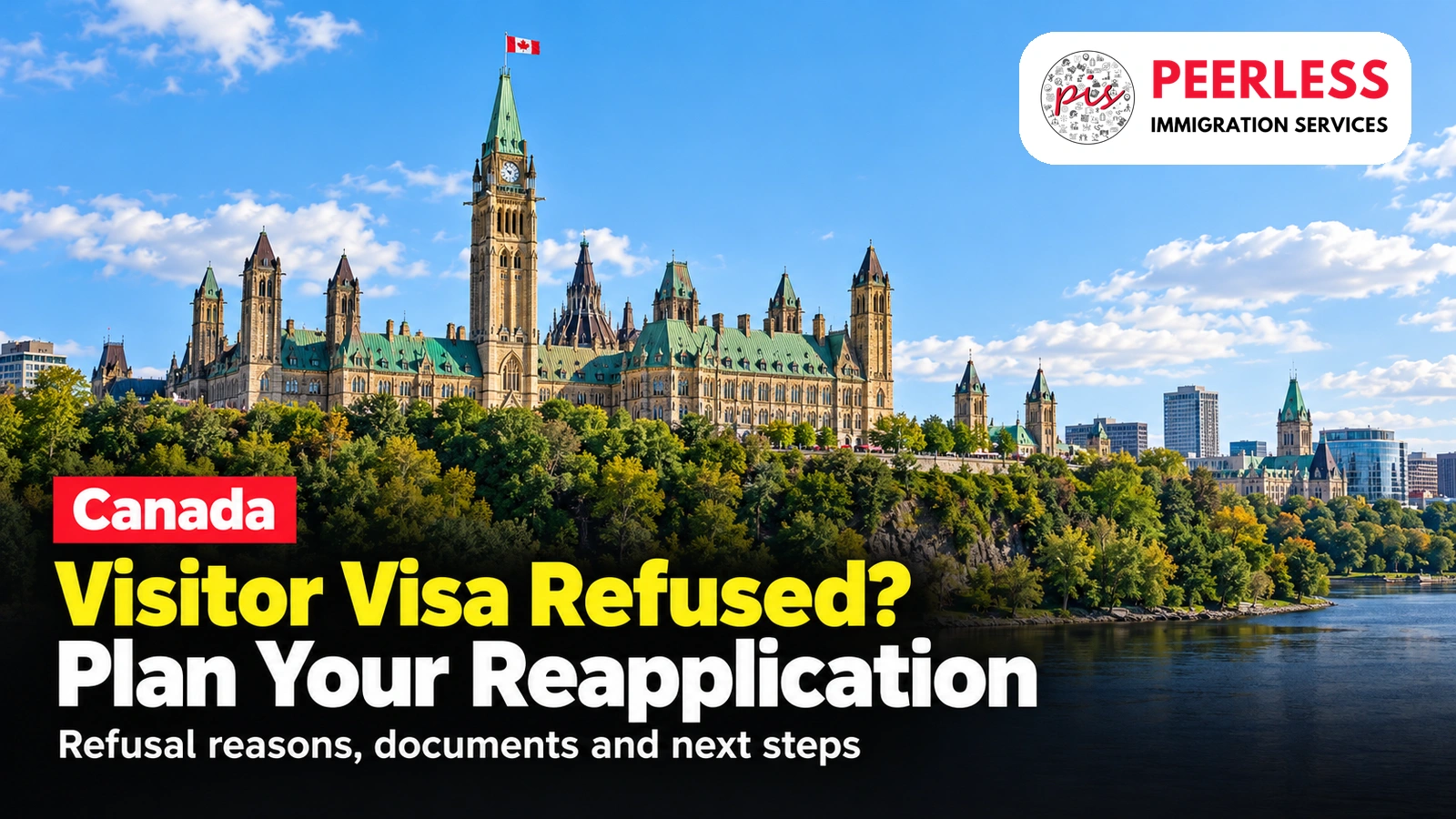
Last updated: 26 October 2026
If your Canada visitor visa was refused, the next step is to understand what the officer was not satisfied about. A second application needs evidence that addresses those concerns. A longer covering letter or a different consultant cannot, by itself, change the facts of the case.
This guide focuses on preparing a reapplication from India: reading the decision, deciding whether more records are needed, and identifying what should change before you pay again. For the wider route, see our Canada tourist visa guidance.
IRCC requires a visitor to establish a temporary purpose, enough money for the stay and reasons to leave Canada when authorised. Relevant ties can include employment, home, financial assets and family. Health, criminality and other inadmissibility issues can also affect eligibility.
A relative's invitation does not answer every one of these questions. Likewise, owning property does not explain the proposed trip or how it will be funded. Read the concerns together rather than treating one document as a guaranteed solution. These are eligibility considerations, not a ranking of refusal rates.
Source: IRCC visitor eligibility.
Keep the refusal letter, the submitted forms and every document from the earlier application. IRCC now provides officer decision notes with refusal letters for most temporary resident applications, including visitor visas. The note is sent to the applicant or authorised representative; some information may be removed to protect sensitive material.
Check what was already provided before paying for a separate records request. The refusal letter identifies the decision grounds; the accompanying note may explain how the officer assessed your evidence. Compare both with the actual submission, rather than a remembered summary of it.
Source: IRCC officer decision notes.
A further request for application records, often called a GCMS-notes request, can be useful where the available explanation is incomplete or a reviewer needs to understand the file more fully. It is not a compulsory step before every reapplication and does not overturn the refusal.
For an Access to Information Act request, IRCC charges CAD 5. The requester must be a Canadian citizen, permanent resident, or an individual or corporation currently in Canada. An Indian applicant in India who does not meet those criteria needs an eligible requester, with the required consent when someone requests another person's information. A provider's service charge is separate from the government fee.
Source: IRCC access-to-information requirements.
IRCC states that applicants can reapply for a temporary resident visa at any time. That does not mean immediate resubmission is useful. Follow any restriction in your decision and address any inadmissibility finding before assuming an ordinary reapplication is appropriate.
The practical test is whether you have new information or documents addressing the refusal. IRCC warns that submitting the same information again, even through a representative, is unlikely to change the result. Simply waiting several weeks without changing the evidence does not answer the original concern.
If you believe the process was unfair, seek prompt advice from a Canadian immigration lawyer about whether judicial review is appropriate. A fresh application and a court challenge serve different purposes; do not treat one as a substitute for assessing the other.
Sources: IRCC guidance on applying again; IRCC report on temporary-resident refusal remedies.
The following are practical examples of evidence to review, not a universal checklist or an assurance of approval. The documents must be genuine, relevant and consistent with your circumstances.
| Concern to address | Evidence to review for the new application |
|---|---|
| Purpose and length of visit | A realistic itinerary, accommodation arrangements and invitation or relationship evidence where relevant. Explain why the proposed dates fit the purpose. |
| Employment and return plans | A current employer letter confirming role, employment dates, salary and contact details; leave and expected return arrangements where applicable. |
| Financial position | Bank statements and an explanation of who pays for the trip. IRCC recommends at least six months of account details to understand the financial position. |
| Home-country ties | Evidence of the actual employment, family, home or financial commitments relevant to your return. Avoid relying only on an asset valuation. |
| Travel and application history | Passport pages, visas and entry/exit records where relevant, consistent forms and a clear account of the earlier refusal. |
There is no single bank balance that guarantees a visitor visa. IRCC says the amount needed depends on the length of stay and accommodation arrangements. Explain the whole funding plan rather than presenting a headline balance without context.
Source: IRCC application and supporting-document guidance.
| Item | Government charge |
|---|---|
| New visitor visa application, per person | CAD 100 |
| Biometrics, per person, if required | CAD 85 |
| Access to Information Act request, if needed | CAD 5 |
Refusal does not automatically require fresh biometrics: temporary-resident biometrics remain valid for ten years even after refusal. Confirm your own validity and follow the new application's instructions. Translation, document preparation and professional-service costs are separate.
On 26 October 2026, IRCC's tool displayed 29 days for a visitor visa application from India, with a published update date of 21 October 2026. This is a changing estimate, not a maximum, guaranteed decision date or special timeline for refused applicants. The processing period does not include the time needed to give biometrics.
Sources: IRCC fees; biometrics after refusal; official processing-time tool.
First review the earlier submission and reasons. Next identify what has changed and obtain supporting records. Then prepare accurate current forms, a focused explanation linking each concern to evidence, and the documents applicable to your visit. Submit the new application with its required fees and complete any further steps requested by IRCC.
Avoid copying the old file, changing the travel story without explanation, or submitting inconsistent employment and financial records. A larger document bundle is useful only when it resolves a relevant question. An incomplete application may be refused; IRCC may request an interview, further information, medical examination or police certificate where needed.
Peerless Immigration Services can help organise your refusal letter, available officer notes and earlier submission into a clear review, identify documentary gaps and prepare an evidence-based reapplication. Appropriate Canadian immigration advice is coordinated with an authorised professional where required. Hiring a representative does not itself improve the approval chances or reverse a decision.
Bring the complete previous application, decision letter, officer note, current employment and financial records, and your intended travel purpose. Read our Canada visitor visa page for general route information.
Request a Visitor Visa Refusal Review
Call +91-8595010514 or email info@peerlessimmigration.com. Peerless Immigration Services, Nehru Place, New Delhi. No visa approval or processing time is guaranteed.
An ordinary refusal does not impose a universal waiting period. Read your decision for any restriction and reapply when you can address the reasons with relevant new information or documents. Immediate repetition of the same file is unlikely to help.
First review the officer decision note that may already accompany your refusal. Further records may help if the explanation remains incomplete, but a GCMS request is not mandatory for every applicant and does not change the decision.
No document automatically fixes it. Relevant evidence may include current employment, return-to-work arrangements, family responsibilities and home or financial commitments. The evidence must explain your own return plans alongside a credible temporary trip.
A new visitor visa application normally attracts the CAD 100 application fee. Biometrics are not automatically repeated after refusal: temporary-resident biometrics remain valid for ten years. A CAD 85 individual biometrics fee applies if fresh biometrics are required.
No. IRCC expressly warns that representation does not itself increase approval chances or change the previous decision. Professional help should focus on understanding the refusal and preparing accurate evidence, without guarantees.
Practical guidance across immigration, international mobility, family visas and language preparation.
Explore skilled migration and permanent residence pathways based on your profile and goals.
Explore PR OptionsExplore eligible job-search visa and residence pathways in selected destinations.
Explore Job Seeker VisasExplore residence options for eligible remote workers and internationally mobile professionals.
Explore Digital Nomad VisasLearn about investment-linked residence options and other eligible European pathways.
Explore Residency Options
Get application guidance for tourism, visiting family and other short-term travel.
Explore Visitor Visas
Explore eligible sponsorship routes for spouses, partners, parents and family members.
Explore Family VisasExplore employer-supported work permit options and suitable overseas employment pathways.
Explore Work PermitsPrepare with guided online lessons, study materials, practice tests and feedback.
Explore Coaching


