

Permanent Residency
Explore skilled migration and permanent residence pathways based on your profile and goals.
Explore PR Options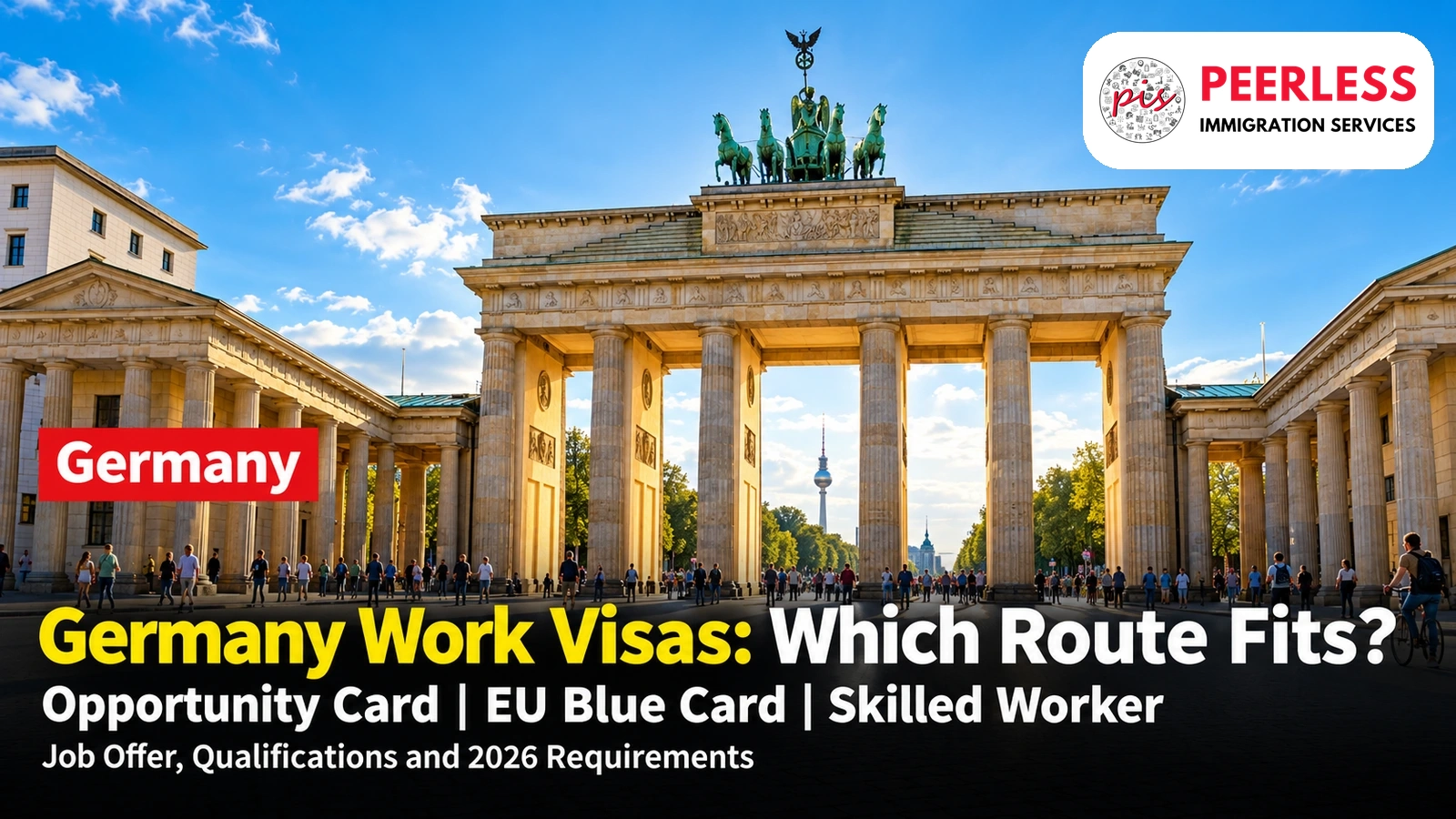
Last updated: 25 October 2026
For an Indian professional considering Germany, the first question is whether there is already a suitable job offer. The Opportunity Card supports a job search. The EU Blue Card and the work visa for qualified professionals are employment routes. Choosing between them requires a review of the qualification, proposed job and financial position together.
This comparison explains where each route fits. Our Germany Opportunity Card guide covers the job-search route in greater detail.
| Decision point | Opportunity Card | EU Blue Card | Qualified professional work visa |
|---|---|---|---|
| Main purpose | Search for suitable employment | Take up qualifying employment | Take up qualified employment under sections 18a/18b |
| Job offer | Not required initially | Required; employment of at least six months | Required; auxiliary work is insufficient |
| Qualification | Recognised-skilled-worker route or qualifying points route | Normally a German/comparable academic or eligible tertiary qualification; a separate IT experience exception exists | Recognised vocational qualification or comparable academic qualification |
| Key financial test | Job-search living costs | Applicable gross salary threshold | Acceptable employment conditions; additional age-related rules may apply |
| Initial residence outlook | Job-search card: up to one year | Contract plus six months, maximum four years | Maximum four years; shorter contract plus six months |
There are two eligibility routes: a German or fully recognised foreign qualification without a points test, or at least six points alongside the underlying qualification and language requirements. The points route requires German A1 or English B2; the recognised-skilled-worker route does not require language proof. German ability remains useful for an actual job search.
The 2026 funding benchmark is €1,091 net per month. For a full twelve months, that is €13,092 before other costs. A blocked account or formal declaration of commitment can establish funding. This money is living-cost support, separate from the visa fee.
The job-search card allows secondary employment totalling 20 hours weekly and qualifying trials of up to two weeks per employer. Finding a job means applying for the appropriate employment residence title; the card does not automatically authorise unrestricted full-time work. These limits are set out in the federal Opportunity Card guidance.
The offered role must match the relevant qualification. Salary is gross annual pay, before deductions. The official EU Blue Card rules distinguish the following cases:
| Case | 2026 minimum gross annual salary |
|---|---|
| General threshold | €50,700 |
| Qualifying shortage occupation, with Federal Employment Agency approval | €45,934.20 |
| Last degree/equivalent obtained less than three years ago, with Federal Employment Agency approval | €45,934.20 |
Illustration: a €48,000 offer exceeds the lower threshold but falls below the general threshold. It cannot be treated as sufficient without establishing the relevant lower-threshold category and the other requirements. A salary figure alone is not an eligibility decision.
The qualified professional work visa may remain relevant. The job must be qualified employment, although it need not relate to the qualification. A licence is necessary for a regulated profession. Federal Employment Agency approval is generally required, including assessment of employment conditions.
For applicants over 45 coming to work in Germany for the first time, the published 2026 requirement is €55,770 gross annually or adequate pension provision. This is a separate consideration from Blue Card thresholds. An offer below €50,700 therefore needs a route-specific assessment rather than an automatic rejection or approval.
Start by establishing the intended route, then organise evidence around it:
The German Missions' academic employment checklist and Opportunity Card checklist describe different evidence requirements. These are not interchangeable document bundles.
The main stages are eligibility and recognition review, document preparation, the applicable Consular Services Portal application and pre-check, followed by the required appointment and decision. Residence permission after arrival must match the intended activity. Professional assistance is useful where degree comparability, a regulated occupation, study-mode evidence or the proposed employment category is unclear.
The published national visa processing fee for applicants over 18 is €75, payable in INR at the applicable appointment-day exchange rate. It is not refunded following refusal or withdrawal; the external service provider charges an additional service fee. Recognition, insurance, travel and residence-permit costs are separate. The German Missions' national visa guidance is the fee and application-process source.
No single numerical processing estimate covering all three routes was established in the official pages reviewed for this comparison. Do not plan a resignation or fixed relocation date around an assumed approval period.
Common mistakes include comparing net pay with a gross salary threshold, claiming a lower threshold without a qualifying basis, assuming every job is qualified employment, and treating job-search permission as full-time work permission. Incomplete documents can lead to rejection. False information or documents can cause refusal and a possible entry ban. Neither consultancy support nor a complete document set guarantees a visa or a job.
Peerless Immigration Services, Nehru Place, New Delhi, can help assess how your qualifications, job-offer position and documents fit your Germany plans. A useful starting point is to share your education, work history and any genuine offer for a profile review.
Call +91-8595010514 or email info@peerlessimmigration.com.
Explore Your Immigration Options
The EU Blue Card and qualified professional work visa require an offer. The Opportunity Card can support an eligible applicant's job search without one.
The general threshold is €50,700 gross annually. The €45,934.20 threshold applies only to qualifying cases described above, with the relevant approval requirements.
Possibly. A recognised qualification and qualified offer may support the sections 18a/18b route, subject to its own requirements. Missing one Blue Card condition does not decide every other route.
A settlement permit is a later, conditional application. The federal guidance describes a possible Blue Card pathway after 27 months with A1 German, or 21 months with B1. Qualified professional permit holders may qualify after three years under the relevant conditions. These periods are not automatic grants; the Opportunity Card itself does not confer permanent residence.
No. An applicant can search from India and, after obtaining a suitable offer, pursue the appropriate employment visa. The choice should follow the actual profile and offer.
Practical guidance across immigration, international mobility, family visas and language preparation.
Explore skilled migration and permanent residence pathways based on your profile and goals.
Explore PR OptionsExplore eligible job-search visa and residence pathways in selected destinations.
Explore Job Seeker VisasExplore residence options for eligible remote workers and internationally mobile professionals.
Explore Digital Nomad VisasLearn about investment-linked residence options and other eligible European pathways.
Explore Residency Options
Get application guidance for tourism, visiting family and other short-term travel.
Explore Visitor Visas
Explore eligible sponsorship routes for spouses, partners, parents and family members.
Explore Family VisasExplore employer-supported work permit options and suitable overseas employment pathways.
Explore Work PermitsPrepare with guided online lessons, study materials, practice tests and feedback.
Explore Coaching


