
Permanent Residency
Explore skilled migration and permanent residence pathways based on your profile and goals.
Explore PR Options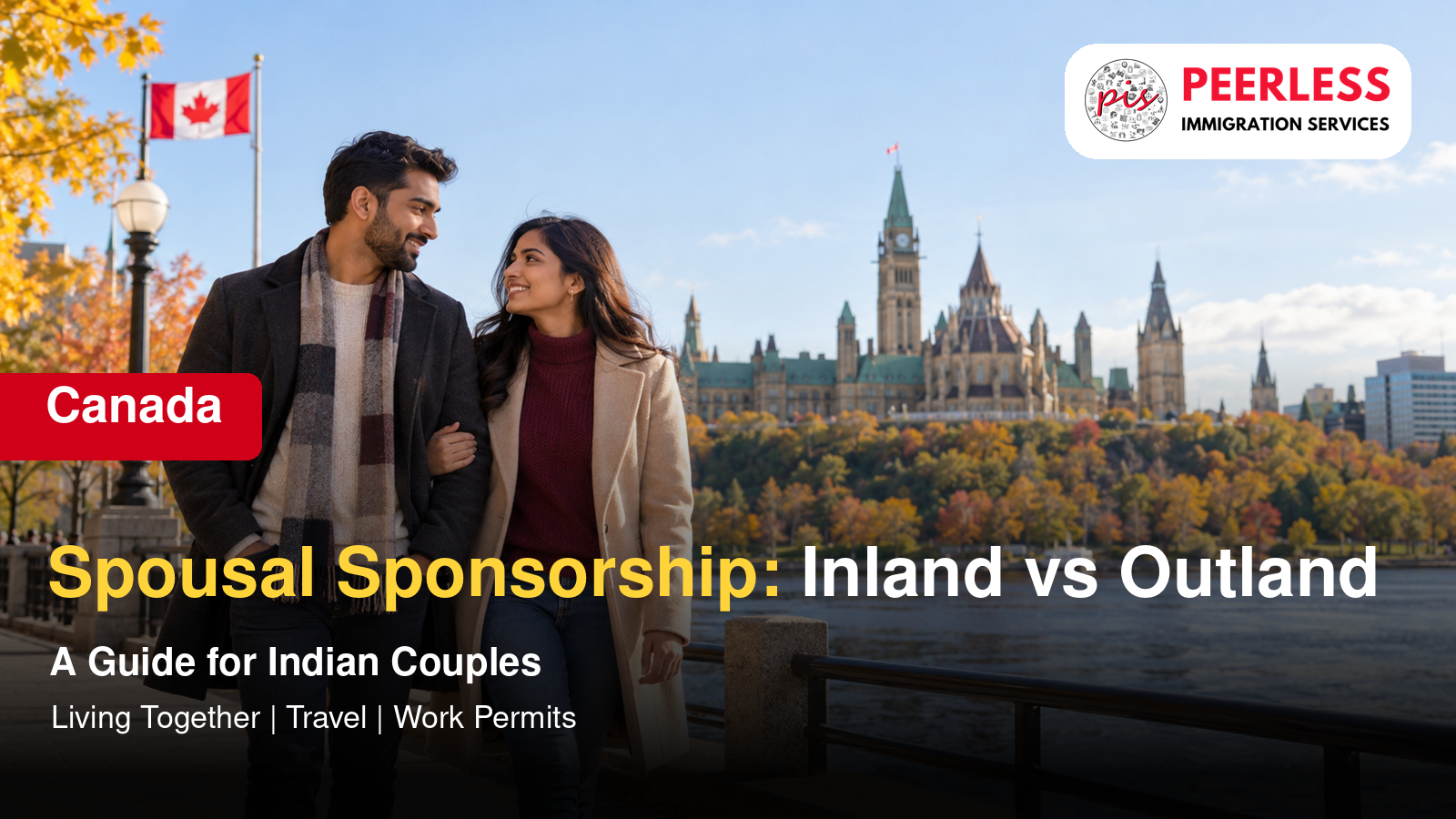
Choosing inland or outland spousal sponsorship starts with where you will live together during processing. The right comparison also covers travel, temporary status and work plans. For Indian couples, these practical details can matter more than an advertised timeline.
This guide compares the two application classes. It complements our inland sponsorship service page and outland sponsorship service page. Requirements were checked against current IRCC guidance on 27 October 2026.
| Application class | When it fits |
|---|---|
| Spouse or Common-Law Partner in Canada Class — commonly called inland | For spouses or common-law partners living together in Canada, with valid temporary status or a qualifying public-policy exemption. |
| Family Class — commonly called outland | For a partner abroad, or someone in Canada who does not plan to remain during processing. |
Being physically in Canada does not automatically require an inland application. IRCC permits Family Class applications in the circumstances above. Choose the class around a realistic living arrangement, not a label alone.
The sponsor must be at least 18 and meet the citizenship or residence requirements. A permanent resident living outside Canada cannot sponsor. A Canadian citizen abroad must show plans to live in Canada when the sponsored person becomes a permanent resident.
Most spouse or partner cases have no minimum income requirement, but exceptions apply where dependent children have dependent children of their own. The undertaking still creates financial responsibilities. Previous sponsorship commitments, certain offences, unresolved defaults or social assistance other than for a disability can affect eligibility. A route comparison cannot replace this initial assessment.
Quebec has additional provincial requirements and an undertaking process. A couple planning to settle there needs a Quebec-specific review; a general outside-Quebec plan is insufficient.
For inland applicants, leaving Canada carries a re-entry risk. If the partner cannot return, IRCC says a new overseas sponsorship application is needed. Consider essential family or employment travel before selecting the class.
A spouse abroad may apply for a visitor visa while PR is pending. An acknowledgement of receipt, or AOR, may allow faster visitor-visa processing, but all visitor-visa eligibility requirements still apply. Sponsorship does not guarantee a visa or entry. A visit and a permanent-residence application remain different decisions.
IRCC’s sponsored-spouse open-work-permit policy can cover eligible applicants living in Canada with their sponsor, including eligible Family Class applicants. A genuine relationship, inclusion in the PR application and normally an AOR are required. The AOR confirms that the PR package passed the completeness check; it is not PR approval.
Temporary status also matters. The policy sets conditions for valid or maintained status and eligible restoration cases. A limited exception allows an application without an AOR where temporary status expires in two weeks or less and a qualifying PR application has been submitted. Applicants processed under the spousal public policy without valid status must normally wait for approval in principle.
Submitting sponsorship alone does not authorise employment. Plan household finances without assuming that a work permit will be approved or issued immediately. This policy should not be confused with open-work-permit rules for spouses of temporary workers or students.
Neither label guarantees an earlier decision. IRCC says processing varies with application volumes and case complexity. A missing document, additional-information request or eligibility concern can affect the case. Use a realistic budget for living apart or living together, rather than choosing solely on another couple’s completion date.
IRCC’s application package includes the document checklist, forms and country-specific instructions. Start from the package that matches the relationship and the applicant’s location. All family members must be declared, including those not accompanying the applicant. Explain missing records with supporting evidence where required; silence is not an explanation.
| Planning check | What to resolve before submission |
|---|---|
| Living arrangement | Where each partner will live and whether essential travel is expected. |
| Status and work | Current permits or visitor status, expiry dates and any separate work-permit eligibility. |
| Application record | Correct checklist, complete forms, country instructions and consistent family details. |
The principal applicant must personally complete the electronic declaration as required. A representative cannot sign it on their behalf. IRCC also states that hiring a representative does not secure special treatment or approval.
Peerless Immigration Services can help organise your circumstances, identify missing information and explain the practical differences between the routes. Bring your proposed living arrangement, status expiry dates and essential travel plans to the discussion. No PR, visitor visa or work-permit outcome is guaranteed.
Call +91-8595010514 or email info@peerlessimmigration.com.
Discuss Your Sponsorship Options
Family Class can be appropriate for someone in Canada who does not plan to stay during processing. Presence alone does not determine the class.
Only with the required authorisation. Eligible sponsored applicants living with their sponsor in Canada may qualify for a separate open work permit, subject to the policy conditions.
Re-entry is not guaranteed. If you cannot return, IRCC says a new overseas sponsorship application is required.
No. Processing depends on the case and current workload; neither class promises a fixed decision date.
No. IRCC states that a refusal under the in-Canada class cannot be appealed through the sponsorship appeal process. Family Class appeal eligibility must be assessed for the particular decision.
Practical guidance across immigration, international mobility, family visas and language preparation.
Explore skilled migration and permanent residence pathways based on your profile and goals.
Explore PR OptionsExplore eligible job-search visa and residence pathways in selected destinations.
Explore Job Seeker VisasExplore residence options for eligible remote workers and internationally mobile professionals.
Explore Digital Nomad VisasLearn about investment-linked residence options and other eligible European pathways.
Explore Residency Options
Get application guidance for tourism, visiting family and other short-term travel.
Explore Visitor Visas
Explore eligible sponsorship routes for spouses, partners, parents and family members.
Explore Family VisasExplore employer-supported work permit options and suitable overseas employment pathways.
Explore Work PermitsPrepare with guided online lessons, study materials, practice tests and feedback.
Explore Coaching


