
Permanent Residency
Explore skilled migration and permanent residence pathways based on your profile and goals.
Explore PR Options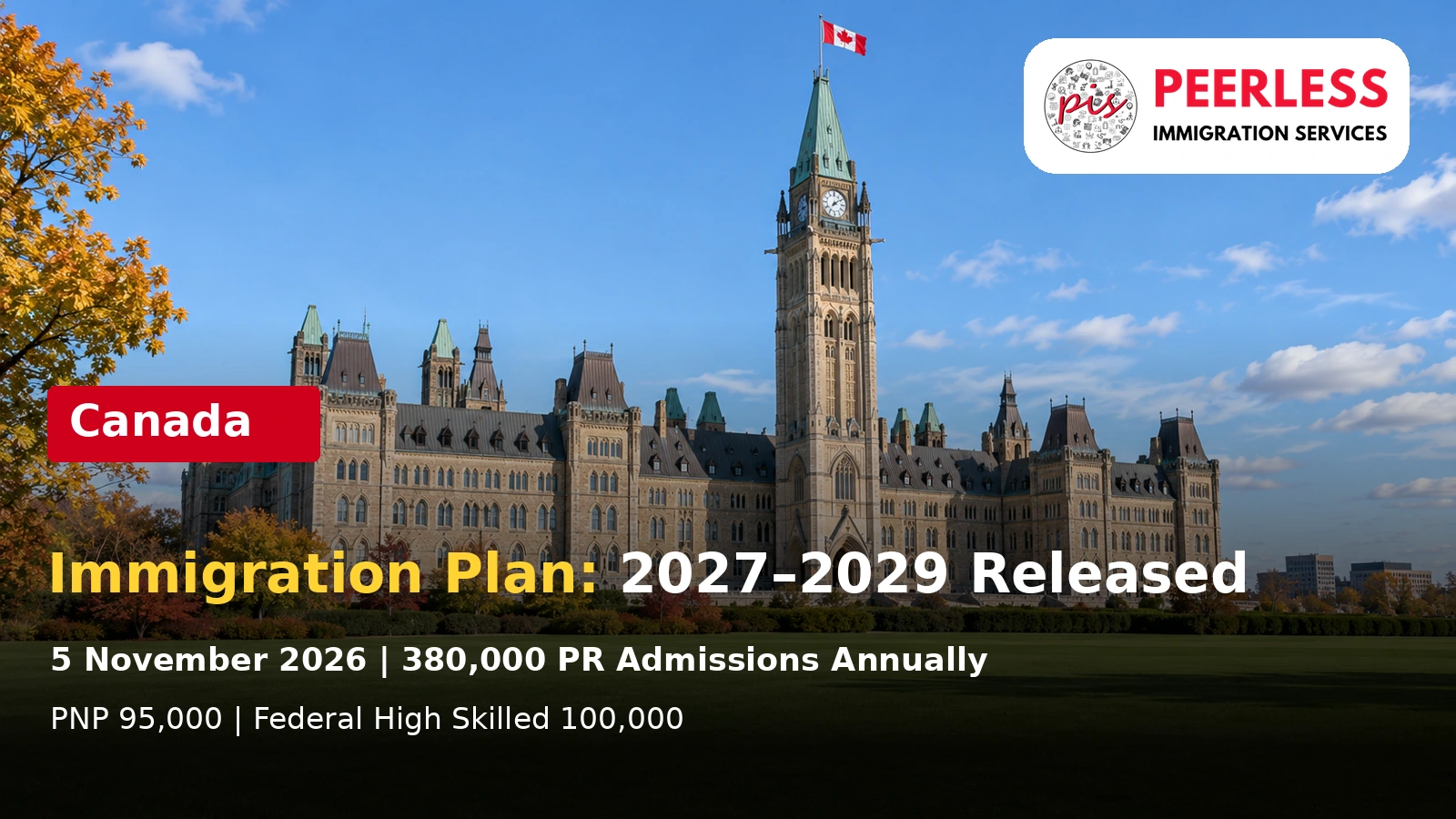
Canada released its 2027–2029 Immigration Levels Plan on 5 November 2026. The base permanent-resident target stays at 380,000 a year, while planned new temporary arrivals remain at 370,000 annually. The important changes are inside the allocation: fewer Federal High Skilled admissions, more provincial and Atlantic spaces, and a separate time-limited transition measure for people already in Canada. This article was verified on 6 November 2026.
For Indian applicants, a stable headline number does not mean unchanged prospects for every route. Below, we compare the new announcement with the 2026–2028 plan currently covered on the Peerless website, then answer the practical questions about eligibility, family, fees, timing and next steps.
The first comparison uses 2027 under both plans. Comparing the old 2026 figure with the new 2027 figure would mix an annual step-down already announced last year with changes made now. The baseline is IRCC’s previous official table; the new figures come from its 2027–2029 supplementary table. Counts, rather than approximate percentages in the older website introduction, are used here.
| Target for 2027 | Previous plan | New plan | Change |
|---|---|---|---|
| Permanent residents: base total | 380,000 | 380,000 | Unchanged |
| New temporary arrivals | 370,000 | 370,000 | Unchanged |
| New workers | 220,000 | 220,000 | Unchanged |
| New students | 150,000 | 150,000 | Unchanged |
| Federal High Skilled | 111,000 | 100,000 | −11,000 |
| Provincial Nominee Program | 92,500 | 95,000 | +2,500 |
| Atlantic Immigration Program | 4,000 | 6,000 | +2,000 |
| Total economic | 244,700 | 244,700 | Unchanged |
| Spouses, partners and children | 66,000 | 66,000 | Unchanged |
| Parents and grandparents | 15,000 | 15,000 | Unchanged |
| Total family | 81,000 | 81,000 | Unchanged |
| Refugees and protected persons | 49,300 | 49,300 | Unchanged |
| Humanitarian and compassionate / other | 5,000 | 5,000 | Unchanged |
Our interpretation: the new plan redistributes opportunities within a stable base total. A higher PNP target is a reason to assess regional fit, not proof that a particular province will invite your occupation. A lower Federal High Skilled target does not establish the next Express Entry cut-off or the number of invitations in a particular draw.
| Annual target | 2027 | 2028 | 2029 |
|---|---|---|---|
| Base PR admissions | 380,000 | 380,000 | 380,000 |
| New temporary arrivals | 370,000 | 370,000 | 370,000 |
| Federal High Skilled | 100,000 | 100,000 | 100,000 |
| PNP | 95,000 | 95,000 | 95,000 |
| Atlantic | 6,000 | 6,000 | 6,000 |
| Federal business | 1,500 | 2,725 | 1,000 |
| Rural Community Immigration Program | 5,500 | 6,000 | 6,500 |
| French-speaking PR admissions outside Quebec | 9.5% | 10.5% | 12% |
Future-year targets are notional and can be adjusted. The rural category is separately identified; it should not be compared as a simple increase against the old grouped pilot line. Quebec economic selection is separate, and its row remains marked “TBD” in this federal table. The French percentages apply outside Quebec and are not extra admissions to add to the PR total.
Budget 2026 announced an opportunity for up to 200,000 people already in Canada to transition by the end of 2027. IRCC describes additional admissions space separate from the regular levels plan, with a workers cohort and a humanitarian cohort, each described as up to 100,000. It is not 200,000 unrestricted new places for people applying from India.
The IRCC backgrounder describes provincial collaboration and additional PNP allocations for the workers cohort. Provinces can also identify existing applications in selected federal pathways, including Atlantic, federal business, Agri-Food and home care worker programs. Reference to a closed program’s existing inventory does not reopen it for new applications.
The humanitarian cohort addresses longstanding cases, including remaining Hong Kong and Ukraine family-reunification pathway applications, people already found eligible on humanitarian and compassionate grounds, and certain in-Canada family applications. The worker measure includes accompanying family members where applicable. Being a visitor, student or worker in Canada does not by itself establish eligibility for either cohort.
Can everyone apply now? The announcement is not a universal invitation or a general first-come application form. It describes targeted processing and provincial action under selected pathways. A person needs the applicable instructions and an eligible case; no universal occupation list, language exemption, work-duration rule or dedicated application fee should be assumed from the headline.
The regular plan and temporary initiatives must be kept separate. Earlier 2026–2027 initiatives cover up to 33,000 workers and 115,000 protected persons and in-Canada dependants. IRCC’s permanent-residence statistics explanation identifies those as additional to the regular plan. They are distinct from the newly announced measure; the full multi-year ceilings cannot all be treated as guaranteed 2027 admissions.
Admissions count people obtaining PR, including eligible accompanying dependants; an invitation round selects applications at an earlier stage. Therefore, do not read 100,000 Federal High Skilled admissions as 100,000 Express Entry invitations or 100,000 principal applicants. Likewise, the Francophone proportion overlaps the plan instead of forming another total to add.
Yes, the announcement does not impose a blanket offshore ban. The Federal Skilled Worker Program remains a route for qualifying foreign work experience, subject to its language, education, skilled-work, selection, funds and admissibility requirements. The new in-Canada measure is a different question from eligibility for an existing overseas route.
Start with the route you actually qualify for. Match your NOC to the work performed, review language results and ECA validity, then assess provincial connections and any genuine qualifying offer. Do not buy an expensive Canadian course or a job offer solely because a national target sounds favourable. No admission target guarantees a job, nomination or PR approval.
A levels plan does not itself award CRS points. Separately, IRCC’s current score notice confirms changes effective 3 November 2026 to Canadian-work-experience and job-offer points, and removal of LMIA and LMIA-exemption requirements for Express Entry job offers. IRCC says recalculation may take up to two weeks, with invitation rounds paused during that process. This is a separate operational change, not a promised date or score for the next draw.
Keep your profile accurate. Entering the pool does not guarantee an invitation. French ability may support a relevant selection strategy, but the 2029 Francophone target is not a language-test exemption or an individual guarantee. The older plan already worked toward 12% outside Quebec by 2029; the new table now includes that year explicitly.
The 370,000 temporary-arrival target concerns specified new worker and student arrivals. It excludes visitors, permit extensions and in-Canada permit applications; PGWPs are treated as a change or extension of status rather than new arrivals in this table. The figures are not a count of every permit issued, and study permission is not a PR promise.
If your permit is expiring, the plan does not automatically extend it. Review a lawful extension, change of status or departure plan in time. IRCC’s work-permit extension guidance recommends applying at least 30 days before expiry where eligible. Do not continue working merely because you have an Express Entry profile or expect a future transition measure.
For an economic PR application, declare your spouse or partner, dependent children and any dependent grandchildren, including non-accompanying family members, as required by IRCC’s family declaration guidance. Family members have their own required checks and documents. Declaration is different from automatic approval or permission to travel before a decision.
Parents are not added as dependants simply because you qualify for economic PR; parental sponsorship or temporary travel requires its own appropriate route. The 15,000 parent/grandparent admissions target is not an announcement of a fresh sponsorship intake. Similarly, the 66,000 spouse/partner/child target is a family-class planning figure, not a guarantee of an individual processing time. The additional in-Canada family-processing measure should not be assumed to cover an overseas spouse automatically.
The plan is not a new visa category with one universal fee. Current standard economic PR charges in the IRCC fee list are shown below in Canadian dollars. These are not an announced tariff for the new time-limited measure.
| Item | CAD |
|---|---|
| Principal economic PR applicant, including right of PR fee | 1,590 |
| Accompanying spouse/partner, including right of PR fee | 1,590 |
| Dependent child | 270 per child |
| Biometrics, where required | 85 per person; eligible family maximum 170 when applying together |
For two adults and one dependent child, those economic PR application fees total CAD 3,450, before biometrics or other expenses. Allow separately for language tests, ECA, medicals, police records, translations, any provincial fee and travel. Settlement funds are money available for your family, not an IRCC processing charge. Requirements and exemptions depend on the program. INR costs vary with exchange rates.
If you are outside Canada, assess an existing eligible PR route rather than the in-Canada transition headline. If you already have a Canadian PR application, identify its program, current stage and province before assuming priority processing. If you hold temporary status, review expiry dates first. In every case, prepare a reliable family and employment history, a realistic budget and current language/education evidence. Do not withdraw an eligible existing application solely because this plan has been announced.
Peerless Immigration Services can help review your profile and route-specific questions, with appropriately authorised Canadian immigration advice where required. Share your age, education, occupation, language results, Canadian status or application stage and family details. Call +91-8595010514 or email info@peerlessimmigration.com.
Practical guidance across immigration, international mobility, family visas and language preparation.
Explore skilled migration and permanent residence pathways based on your profile and goals.
Explore PR OptionsExplore eligible job-search visa and residence pathways in selected destinations.
Explore Job Seeker VisasExplore residence options for eligible remote workers and internationally mobile professionals.
Explore Digital Nomad VisasLearn about investment-linked residence options and other eligible European pathways.
Explore Residency Options
Get application guidance for tourism, visiting family and other short-term travel.
Explore Visitor Visas
Explore eligible sponsorship routes for spouses, partners, parents and family members.
Explore Family VisasExplore employer-supported work permit options and suitable overseas employment pathways.
Explore Work PermitsPrepare with guided online lessons, study materials, practice tests and feedback.
Explore Coaching


