
Permanent Residency
Explore skilled migration and permanent residence pathways based on your profile and goals.
Explore PR Options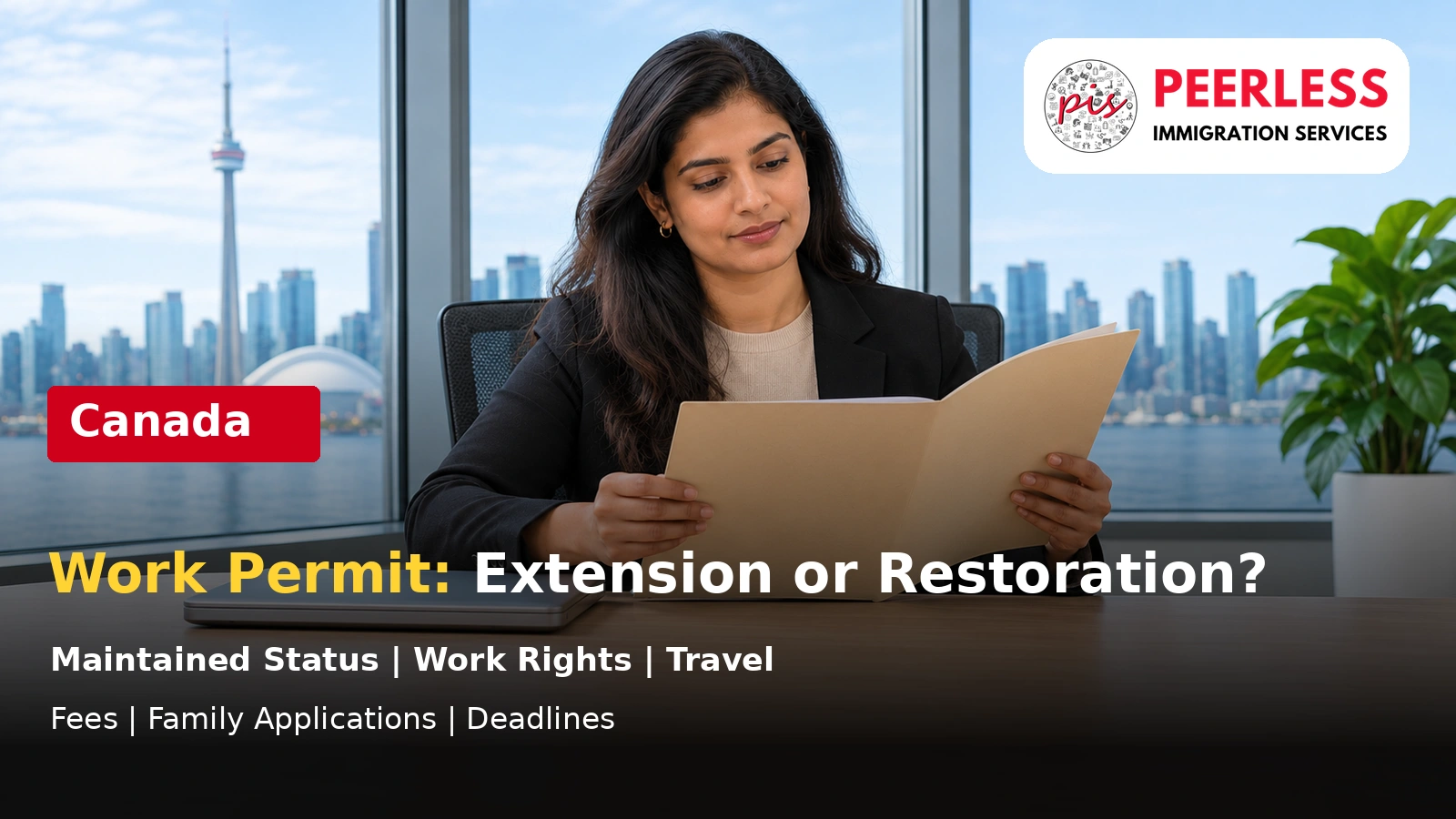
Guidance checked: 7 November 2026. An expiring Canadian work permit creates two questions: can you stay, and can you keep working? An extension, maintained status and restoration have different effects. This guide is for workers already in Canada, including Indian nationals planning their next permit.
| Your situation | What it means |
|---|---|
| Work permit remains valid | Follow its conditions and establish eligibility for your next permit. |
| Qualifying work-permit extension submitted before expiry; you remain in Canada | You may continue working under the existing conditions while IRCC decides. |
| Only a visitor or study-permit application is pending | This does not continue your work rights beyond the work permit’s expiry. |
| Status expired without a timely extension | Stop working and assess restoration promptly. |
| Express Entry profile or PR application only | This does not itself extend your work permit. A separate work-authorisation route is needed. |
IRCC recommends applying at least 30 days before status expires. This is a planning recommendation, not a rule that a later but timely application automatically fails. Online applications must reach IRCC before midnight UTC on the expiry date, which can differ from your local Canadian time.
An extension still needs eligibility. Employer-specific work may require a new LMIA or employer offer under an exemption. Open-permit eligibility must continue. Check passport validity: a permit cannot normally extend beyond it. A pending employer LMIA does not itself extend your status; IRCC has a limited filing provision when the permit expires in two weeks or less and the employer has submitted a complete LMIA or CAQ application.
After a qualifying, timely work-permit extension, continued work while you remain in Canada must follow the old conditions. An employer-specific permit normally means the same employer, job and location. Applying for a different employer does not authorise the switch: approval or specific interim work authorisation is needed. An open-permit holder can usually change employment, subject to any restrictions.
An expired SIN does not by itself end otherwise authorised work during maintained status. Keep the old permit, submission proof and applicable IRCC letter for your employer. IRCC’s guide says an application rejected as incomplete is treated as never submitted, so it does not maintain status. A returned application after expiry needs immediate review; do not simply continue payroll as usual.
Under the standard restoration route, eligible applicants apply within 90 days of losing status. Stop working when authorisation ends. Restoration is not an extra 90 days of work permission, and you normally cannot restart until status is restored and the new permit is issued. A separate “must leave Canada by” date can affect the status-expiry calculation.
Eligibility also depends on compliance with the relevant conditions; approval is not guaranteed. More than 90 days after status loss, the ordinary route generally requires departure and a new application from outside Canada. IRCC lists a specific exception for certain workers with an open-work-permit support letter from a participating province or territory. A PNP profile alone does not establish that exception.
A PGWP is not generally renewable just because more time is needed to qualify for PR. If passport expiry shortened the original PGWP below the period of eligibility, an extension may be available after renewing the passport; IRCC directs these applications to the paper process.
A bridging open work permit is a separate application, not an automatic benefit of entering Express Entry. For the Express Entry route, IRCC requires the principal applicant to meet the Canadian residence/status conditions, have a complete PR application that passed the completeness check, and have an acknowledgement of receipt. Other PR programs have their own requirements. Do not wait for a future invitation without a status plan.
The IRCC fee list checked on 7 November 2026 shows the following standard charges in Canadian dollars. Exemptions can apply in defined cases; paying a fee does not establish eligibility.
| Application or charge | CAD |
|---|---|
| Work permit, including an extension | 155 |
| Open work permit holder fee, where payable | 100 additional |
| Restore worker status and obtain a new work permit | 401.25 = 246.25 restoration + 155 permit |
| Restoration with an open permit, where the holder fee is payable | 501.25 before any biometrics |
| Biometrics, if required for the individual | 85 |
These are government charges, not a complete professional-service quotation. Family applications, translations or other required services can add costs. A visitor restoration charge and a worker restoration-plus-permit total are different services.
Your application does not automatically extend another family member’s stay. Record each person’s document type, expiry date and required application separately. A spouse may qualify for an open work permit only under the applicable family or PR pathway; it is not automatic because you filed an extension. Children’s visitor or study arrangements also need their own assessment.
If accompanying family members have lost status, each needs a separate restoration application and fee. IRCC does not offer a group or family restoration rate. For visitor extensions, see our visitor record guide; visitor status does not provide permission to work.
A work permit is not a travel document. Re-entry may require a valid visa or eTA, depending on your circumstances, and a border decision is still required. If your renewal is pending when you return, you may be admitted as a visitor and cannot resume work until the renewal is approved. If it was approved while you were away, you may be admitted as a worker. Review travel and work arrangements before booking.
Prepare passports, permits, submission confirmations, decisions and relevant employer evidence. Include each family member’s deadlines and, for bridging-permit review, the PR acknowledgement. A saved online form is not a submission.
Peerless can help organise the appropriate review through its work permits and employment services. An extension application is not a promise of approval or a guaranteed processing date.
IRCC: Work while waiting | Extension timing | Restoration | Fee list | Travel | Bridging permits | PGWP duration | In-Canada application guide | Family work permits.
Share your permit conditions, expiry dates, application history and family circumstances for a review of the relevant pathway. Canadian advice or representation requiring authorisation should be handled by an appropriately authorised professional. No job, permit or PR outcome is guaranteed.
Call +91-8595010514 or email info@peerlessimmigration.com.
A qualifying application submitted before expiry can allow continued work under the old conditions while you remain in Canada. A visitor or study application does not continue those work rights.
No. The standard 90-day period is an application window for eligible restoration applicants, not work permission. Normally, wait for restored status and a new permit before restarting.
No. A profile is not a complete PR application. Bridging-permit eligibility and the separate application requirements must be met.
The listed standard total is CAD 401.25 for restoration and a new work permit. Add CAD 100 for an open-permit holder fee where payable, plus biometrics if required.
No. Address each person’s status and eligibility separately. Family members needing restoration each apply and pay separately.
Not automatically. You need the relevant travel documents and permission to re-enter. If the renewal remains pending and you return as a visitor, you cannot work until it is approved.
Practical guidance across immigration, international mobility, family visas and language preparation.
Explore skilled migration and permanent residence pathways based on your profile and goals.
Explore PR OptionsExplore eligible job-search visa and residence pathways in selected destinations.
Explore Job Seeker VisasExplore residence options for eligible remote workers and internationally mobile professionals.
Explore Digital Nomad VisasLearn about investment-linked residence options and other eligible European pathways.
Explore Residency Options
Get application guidance for tourism, visiting family and other short-term travel.
Explore Visitor Visas
Explore eligible sponsorship routes for spouses, partners, parents and family members.
Explore Family VisasExplore employer-supported work permit options and suitable overseas employment pathways.
Explore Work PermitsPrepare with guided online lessons, study materials, practice tests and feedback.
Explore Coaching


