

Permanent Residency
Explore skilled migration and permanent residence pathways based on your profile and goals.
Explore PR Options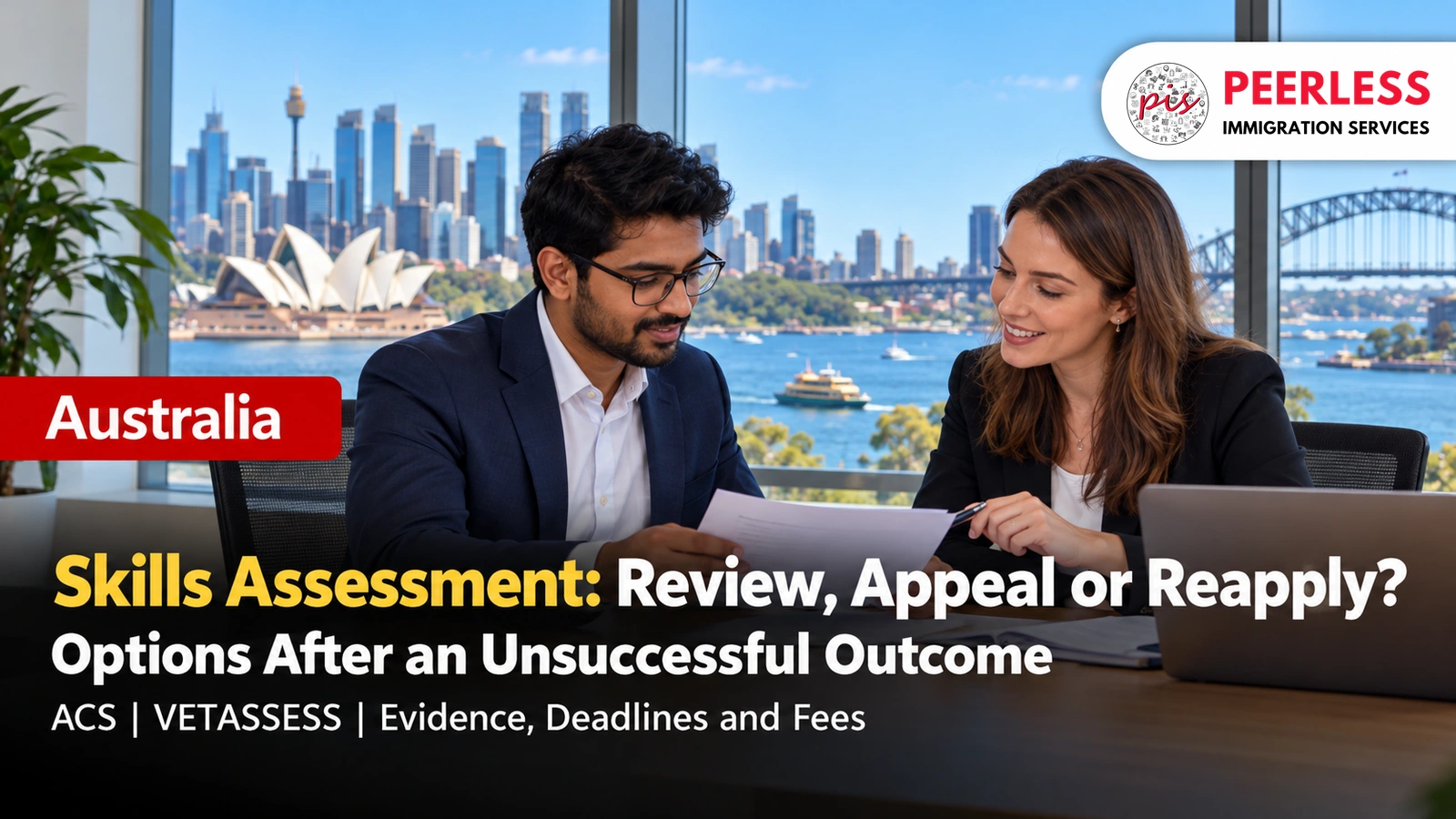
Last updated: 24 October 2026
An unsuccessful Australian skills assessment does not always mean you need to start again. The right next step depends on why the outcome was negative, which assessment program you used, and whether your evidence or circumstances have changed.
For an Indian applicant, the first task is to protect the correct deadline. ACS appeals, VETASSESS professional reviews and trade assessment reviews do not follow one common rule. Sending a stronger employment letter through the wrong process can cost time without resolving the original problem.
| Option | The question it should answer |
|---|---|
| Review or first-stage appeal | Was the original decision incorrect, or can relevant evidence address the stated reason? Whether new evidence is allowed depends on the program. |
| Further appeal | Is there a specific reason to challenge the review result? This is not necessarily another opportunity to add documents. |
| Reassessment or new application | Has something material changed—such as training, experience, evidence or an appropriate occupation choice—and which route can consider it? |
These are practical distinctions, not interchangeable application names. The assessor’s own process controls what can be submitted. Our Australia skills assessment guide explains the wider roles of ACS, VETASSESS, Engineers Australia and TRA.
Read the qualification result, employment result and any recognised dates separately. “Not suitable” may involve more than one issue. Equally, a suitable result that recognises less employment than expected needs a different discussion from an entirely unsuccessful assessment.
Make a short list of each disputed finding and the document that could address it. For example, if the concern is the relevance of your duties, a salary increase letter will not by itself explain your work. If the concern is a qualification’s subject content, an employer’s recommendation will not replace academic evidence.
Keep the original submission intact. A review needs a reliable record of what the assessor received—not a reconstructed folder containing only the documents you wish had been submitted.
ACS provides a Level 1 internal appeal within 60 days of the assessment letter date. A senior assessor who was not involved in the original assessment considers the case, and relevant new evidence may be provided.
After completing Level 1, a Level 2 external appeal is available within 30 days of receiving the Level 1 outcome. New supporting evidence cannot be introduced at Level 2. The published policy treats that outcome as final.
The practical implication is to identify missing evidence early. Do not hold an important document back assuming that every appeal stage offers the same opportunity. An appeal also needs grounds connected to the assessment; disappointment with the result alone does not explain an error.
If your result is suitable but recognises fewer years than expected, identify the exact assessment dates you dispute. That is a different issue from challenging an entirely unsuitable outcome.
For an unsuccessful professional assessment, VETASSESS allows a review within 90 days of the original decision’s issue date. New evidence may be included. A further appeal must be submitted within 90 days of the review decision; it may also include new evidence.
For a Not Suitable result, its published reassessment rules distinguish the same occupation after the 90-day review period, up to 12 months from the original decision, from a different occupation within that 12-month period. These options should be matched to your case rather than used simply because one sounds faster.
Do not assume a professional review can be put through Priority Processing: VETASSESS excludes reviews from that service. A complete, relevant evidence package matters more than repeated follow-up requests.
For trade assessments delivered by VETASSESS, a review must be requested within 28 calendar days of receiving the unsuitable outcome. It examines the original decision; later employment or training cannot be added, and previously unsubmitted documents are considered only exceptionally.
A reassessment can instead address identified skills gaps after further training or employment, with new evidence, within 12 months of receiving the original outcome letter. A technical or practical review is a desktop review, not another interview or practical test.
These are VETASSESS’s trade program rules. They must not be applied automatically to TRA’s documentary Migration Skills Assessment program, another approved training organisation, Engineers Australia or any other authority. Identify the program named on the letter before calculating a deadline.
The following are assessor charges, separate from Peerless professional fees. They do not include the cost of a visa application, translations or obtaining additional records.
| Service | Published fee | Published timing |
|---|---|---|
| ACS Level 1 appeal | $516, as listed by ACS | Website FAQ: approximately 2–4 weeks |
| ACS Level 2 appeal | $620, as listed by ACS | Website FAQ: approximately 2–4 weeks; its appeal policy allows up to 60 days |
| VETASSESS professional qualification-only review | AUD 356 excluding GST / AUD 391.60 including GST | Review estimate: 7 weeks |
| VETASSESS professional employment-only review | AUD 637 excluding GST / AUD 700.70 including GST | Review estimate: 7 weeks |
| VETASSESS professional review of qualification and employment | AUD 955 excluding GST / AUD 1,050.50 including GST | Review estimate: 7 weeks |
| VETASSESS professional appeal | AUD 1,132 excluding GST / AUD 1,245.20 including GST | 12 weeks |
The VETASSESS fee category depends on the qualification/employment outcome and occupation group; it is not a free choice of the cheapest service. Its GST treatment depends on Australian tax residency. Being an Indian citizen does not itself determine that treatment.
Processing figures are estimates, not a promise. VETASSESS notes that complexity or insufficient information can extend a review. ACS’s website estimate and its policy’s longer Level 2 timeframe should both be allowed for when planning. A successful challenge does not automatically establish a right to a fee refund: the applicable refund conditions still matter.
To understand the problem, our team needs:
This is a consultation checklist, not a claim that every assessor accepts every item at every stage. A useful submission connects evidence to the reason for the outcome. More pages, repeated references or a strongly worded cover letter cannot replace an unmet requirement.
A different occupation may be worth assessing where your genuine qualifications and duties support it. VETASSESS expressly provides a change-of-occupation reassessment option under its published conditions. That does not mean any unsuccessful applicant can switch to a more attractive code and obtain a suitable result.
Start with the work you actually performed. Do not rewrite your career to match an occupation’s description. For ACS, the appeals policy also identifies changing the nature of the original assessment, including the ANZSCO code or pathway, as relevant to refund discretion; an appeal is not a shortcut for redesigning the original case.
A skills assessment outcome is an assessor’s decision, rather than a Home Affairs visa refusal. However, where your intended visa requires a suitable assessment, an unsuccessful result cannot be used as though that requirement has been met. Home Affairs lists a suitable occupation assessment among the requirements for the subclass 189 points-tested route.
If you already have an invitation or visa matter in progress, the dates and conditions need individual attention. Lodging an assessor review should not be treated as an automatic extension of a separate immigration deadline. Our Australia PR pathway guide explains the broader visa planning context.
We can organise the decision and evidence into a clear case summary, identify the stated gap, distinguish a possible assessment error from a genuine eligibility shortfall, and explain which next step merits consideration. Where new qualifications, training or employment are needed, we will explain that limitation rather than recommend paying for the same unsupported application again.
Send the full outcome letter first, along with the original submission if available. Our Nehru Place team can discuss the appropriate scope of assistance and professional fees before further work. Only the relevant authority decides the assessment outcome; no review, appeal, invitation or visa approval is guaranteed.
Get Assistance With Your Skills Assessment
Call +91-8595010514 or email info@peerlessimmigration.com. Peerless Immigration Services, Nehru Place, New Delhi.
That depends on the decision’s reason and the available process. A claimed error, missing evidence and skills gained after the assessment are different situations. Establish which one applies before paying another fee.
Some stages allow them and others do not. ACS Level 2 excludes new evidence. The table and program sections above explain the distinctions; there is no universal evidence rule.
The two decisions are separate, but an unsuccessful assessment can prevent you meeting a visa’s skills requirement. An existing invitation or application needs case-specific advice rather than an assumption that an assessor appeal resolves it.
Possibly, if your actual work and qualifications support it and the relevant assessment process allows it. An occupation change should follow evidence, not a preferred points score or invitation rumour.
Refunds are conditional. For example, a result changed because of new evidence is different from an original assessment error. Budget for the fee rather than assuming a refund.
Share the complete decision letter and submission immediately so the applicable route and date can be identified. A general enquiry or complaint should not be assumed to replace a formal review or appeal.
Practical guidance across immigration, international mobility, family visas and language preparation.
Explore skilled migration and permanent residence pathways based on your profile and goals.
Explore PR OptionsExplore eligible job-search visa and residence pathways in selected destinations.
Explore Job Seeker VisasExplore residence options for eligible remote workers and internationally mobile professionals.
Explore Digital Nomad VisasLearn about investment-linked residence options and other eligible European pathways.
Explore Residency Options
Get application guidance for tourism, visiting family and other short-term travel.
Explore Visitor Visas
Explore eligible sponsorship routes for spouses, partners, parents and family members.
Explore Family VisasExplore employer-supported work permit options and suitable overseas employment pathways.
Explore Work PermitsPrepare with guided online lessons, study materials, practice tests and feedback.
Explore Coaching


